Saturday, March 28, 2009
Blame!
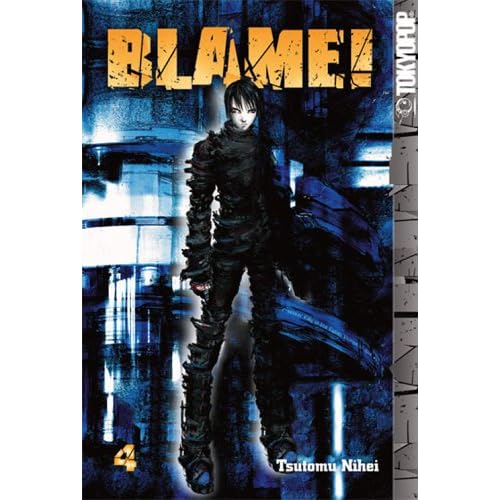
Tsutomo Nihei is the only creator who's works I own in three different languages. It all started back in 2002 when I went to Russia for school. I didn't buy any of his comics there (the only comics I managed to find that time were reprints of American superheroes, I think I still have an issue of Gen13 somewhere), but I did become friends with one of the other guys on the trip. He was also into manga and anime, and upon returning to Canada he lent me a bunch of stuff.
While I was looking through his collection, I noticed he had a bunch of books in Japanese, from a trip he'd taken there the year before. I didn't really pay attention to them, as I can't read Japanese and generally prefer to actually read my comics, but I took volume one of Blame, because I liked the art style. Soon I came back and borrowed volumes 2 and 3. This comic was great! And there was barely any dialogue so it didn't matter that much that it was in Japanese. All the English I needed was printed on the dust jacket "Adventure Seeker Killy in the Cyber Dungeon Quest." What did that even mean?
The next year I was in Montreal for a student journalism conference, and when I wasn't making a new friend I went looking for comics. I drooled over all the amazing hardcover collections you could get, but the only comics I actually picked up where a cheap used copy of the Invisibles volume 2, and three assorted volumes of Blame! (somehow even cheaper than English manga).
An aside: How often does that happen now? When I was a kid reading comics I didn't really care what number an issue had. Sure it was exciting when I eventually got every issue of a series or story line, but if I only had some I didn't care that much. I have three random volumes of DragonBall/Z in French too. Why don't I do that any more? About the only time I've thought of picking up the new volume of a manga without reading earlier ones is Monster, where I stopped reading fairly early, but heard such good things I thought about checking out a later volume. I didn't though.
Okay, so back to Blame! I can't actually remember what volumes of Blame I got (2, 3, and 5 maybe?), but I was excited to have them. And now I could even read them! Even if my French wasn't that good. I could at least find out the name of the main character (Killy!) and what sound his "emetteur positronique" makes.*
Some of the French editions are really nice by the way. They're flipped, and slightly smaller than most manga is put out here, but apart from that they're beautiful packages. Dustflaps, colour pages at the begining, translated sound effects, really nicely put together in general. The only real downside being that they've taken the ! off of the title, and don't match the others on my shelf.
A few years later in 2004 I was Montreal again and bought another couple of volumes from the same CD/comic store (I think it's called C'Dment, but I can't find it online). And came incredibly close to buying Nihei's art book at the Beguiling in Toronto (I sort of wish I had, but at the time I had not very much money).
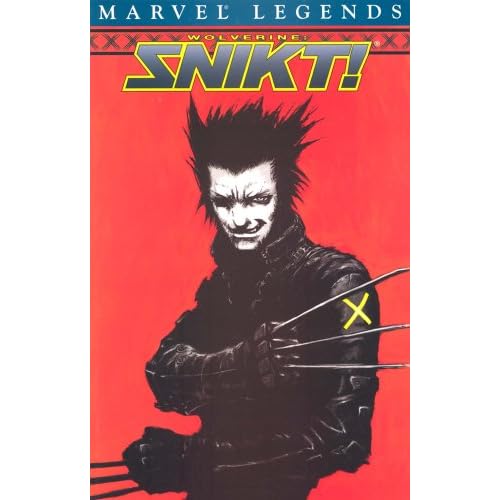
Something I did buy around this time was the incredibly oddity of Snikt, Nihei's Wolverine comic. I think it came out before the manga boom really hit, and the graphic novel was in print for about a day and has never come back into print. I've been confused about this ever since, as you'd think that a comic by an actual Japanese artist with a following would be something Marvel would want to put out in digest format. When Blame! starting coming out in English I figured Marvel would rerelease it, but they didn't. When the Halo graphic novel, featuring a story by Nihei that I totally couldn't understand as I've never really played Halo, came out from Marvel I figured Marvel would rerelease Snikt, but no, never. Sigh, I just don't understand.
Anyway, finally, Blame! did start coming out in English. About a month (or less?) before I left the country for over two years. I managed to buy volume one, but left it...somewhere... (Korea?) I did come close to buying a full run of Blame in Korean for dirt cheap at a comic library store in Korea that was closing, but I decided if I was going to buy the rest of the series I was going to get it in English. One of my students did buy it, but he didn't like it that much. The fool!
After living and traveling in Asia for a while, I decided to go back to Canada, but not before stopping in Japan. I spent a lot of time looking at comics there, but because I didn't have much room to carry stuff I limited myself to just a few volumes of comics I couldn't read. Two volumes each of Abara and Biomega, both by Nihei and found in a Book Off (oh Book Off!).
I also picked up the anime while in Malaysia (?) and when I watched it found it to be incredibly bizarre. I found out it was original a series of animations on the internet. And it's...disjointed. It seems to just take the animators favourite bits and animate them, so there's not real plot there (as much as there is a plot). It's just Killy fighting things. The weird music and sound effects, nonsensical plot, but beautiful art work made me think of it more as an art film than anything else.
When I got finally got back to Canada I worked in a comic shop for a while, where I got volumes 8-10 of Blame, but discovered that 1 and 4 were unavailable for some reason. I eventually found volume 1, and then 4, for sale (cheap!) in a couple of comic shops here, but after almost seven years, three languages and I don't even remember how many countries visited it's kind of bizarre to have the final volume I read by number 4.
Does it solve any long standing plot points? Does it throw light onto the world Killy inhabits? Well, not really. I even started rereading the series at volume one last week, and when I started reading volume four a few days ago I didn't even remember what had happened at the end of volume three (well, I was reading it in French).
Still, it hardly even matters to me. Killy wanders around a world made up entirely of crazy architecture, megastructures, killer robots, and humans who are oddly disproportionate to each other, and that's all you need to know. I could probably read this series in any order and it wouldn't matter to me. I could read this stuff all day.
*Supposedly the comic was supposed to be named the sound a gun firing. Blam! But Nihei's (or someone's) English skills ended up making it the much cooler sounding Blame!

Friday, March 27, 2009
Kurosagi Corpse Delivery Service
I have a problem with manga: I can never remember the character's names. Sure I know who they are, I know how they act, what they want, why they do what they do, I just have no idea what to call them other than "that guy with the weird hair" (isn't that everyone in manga?).
I mean, I've read twenty something volumes of Eyshield 21*, and I doubt I could name even half the cast.
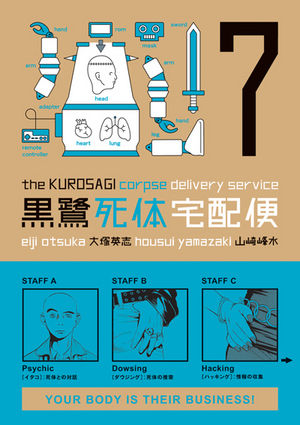
The same problem presents itself to me with Kurosagi Corpse Delivery Service, which is probably my favourite manga coming out right now. And yet, what are the characters names? I just finished reading volume seven an hour ago and...I don't know. I can just identify them by the way they're described on the cover (psychic, dowsing, hacking, embalming, channeling, puppet).
Is it just because they have Japanese names, which I find to be just random jumbles of sounds when I'm reading them? I'm bad with names in real life too, so maybe I just sufer from this in general (who were those people I met at that party last night?). Yet I seem to be able to remember superhero codenames (and their backstories!) with ease.
But all this is beside's the point: Kurosagi is one of the best comics out there right now hands down. Despite this, when volume seven opened I was a little disapointed. Why? Because the incredible cliffhanger from volume six (which, apart from the Jack the Ripper side story, was one of the best comics I read last year) was completely ignored. The notes at the annotations at the back say that it's supposed to be picked up at some point in the future, but blah.
Still, that feeling didn't last long, as this was yet another volume of gripping, corpse delivery**. Okay, so this volume dosesn't really have any corpse delivery, and instead the Buddhist university graduates (finally! A degree less useful than mine) are doing various jobs to pay the rent. Moving gravestones to a new cemetary, moving box after box of manga for an artist, moving stuff on a movie set (hey! it's just like all those university graduates I know working in construction), and oh, one of them gets to do some makeup at the movie too. But still, "I talk to/find dead people" isn't the best skill to have in the job market.
The first story in this volume has probably the most insane concept that we've seen so far. I don't really want to give away much, though the cover sort of does that anyway, but I will say it involves a robot.
One of the other joys found in this manga are the copius editor's notes found in the back, and written by Carl Gustav Horn, who's pretty awesome. The notes aren't just by him of course, some are from the translator, some are from the letterer, some of them are just random anecdotes that are vaguely related to what's actually happening in the comic. But in between those, there're also incredibly informative notes. Sure, some of them are just explaining in-jokes, but others actually help you understand the story by explaining cultural references that might go over the heads of people that aren't Japanese (or extreme fans). How he figured out that each book's chapter titles are songs from old Japanese singers is completely beyond me. If only every manga had notes like this.
To be honest, based on the other works by the creators involved in this series I'm surprised I enjoy it as much as I do. Mail didn't do much for me (though I only read volume one), and I didn't even notice the character from that the first time I read the story where he gueststarred in Kurosagi. While MPD Psycho just left me confused, what is going on there? Despite that, Kurosagi Corpse Delivery service is well worth checking out. Black Jack's in volume 6! (I think.)
*Which is incredibly good by the way, you should defnitely read it, even if you have absolutely no interest in football. How are they going to win the Christmas Bowl?! How many more volumes can the series go on for?
**Which, based upon Smuggler, the other manga I bought at the same time as Kurosagi volume one, is an actual subgenre.
Tuesday, March 24, 2009
Black Jack!
A visual comparison between different editions of Black Jack. With terrible quality photographs! (Click for bigger versions, or go to the flickr page.
First up a page from the Viz version of Black Jack:

Now the same page from the Vertical version (please excuse the terrible quality of this image):
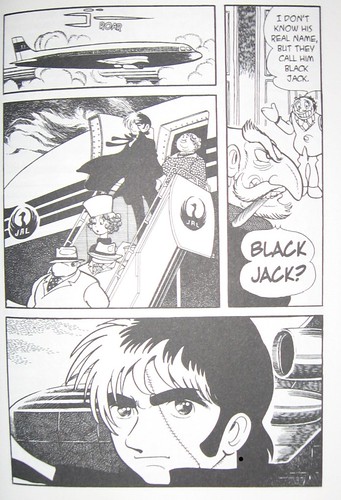
And now, a photo of a postcard showing Tezuka's original art from the same page:

Check out those corrections! And the amount of detail totally lost in the Viz version.
I went back and forth on which translation I preferred, but the lettering on that page of the Vertical one is waaaay better.
Also of interest here are a couple of other pages (without Tezuka originals).
Viz:

Vertical:
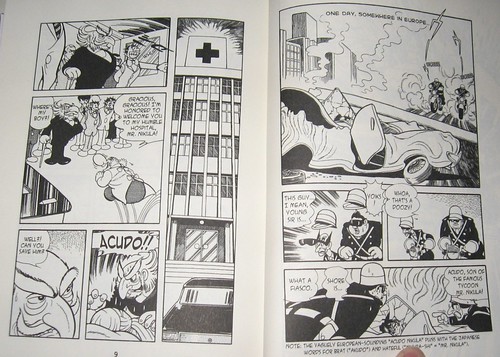
What you should be able to notice here, despite the terrible image quality, is the large amount of gray shading in the Viz edition that isn't evident at all in the Vertical edition, leading me to assume the Viz version was printed from a colourized version. Ooooh.
And speaking of colour Tezuka, I recently got an awesome set of postcards reprinting covers to a bunch of his early work. Here's a bit of a preview, I'll try and post more later.
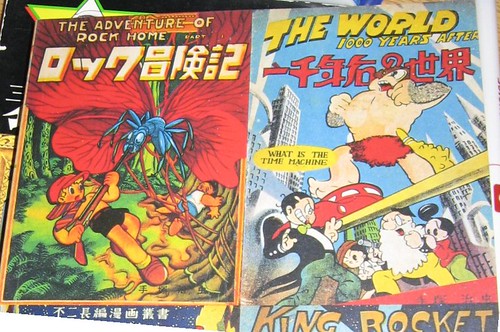
Oh Tezuka!
First up a page from the Viz version of Black Jack:
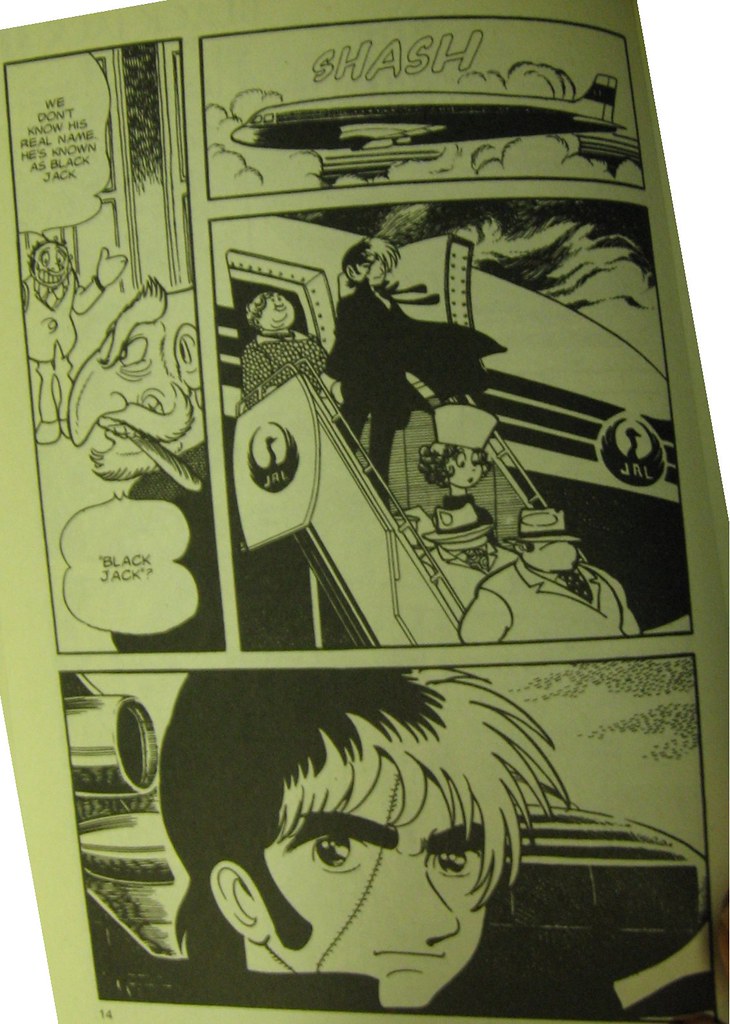
Now the same page from the Vertical version (please excuse the terrible quality of this image):
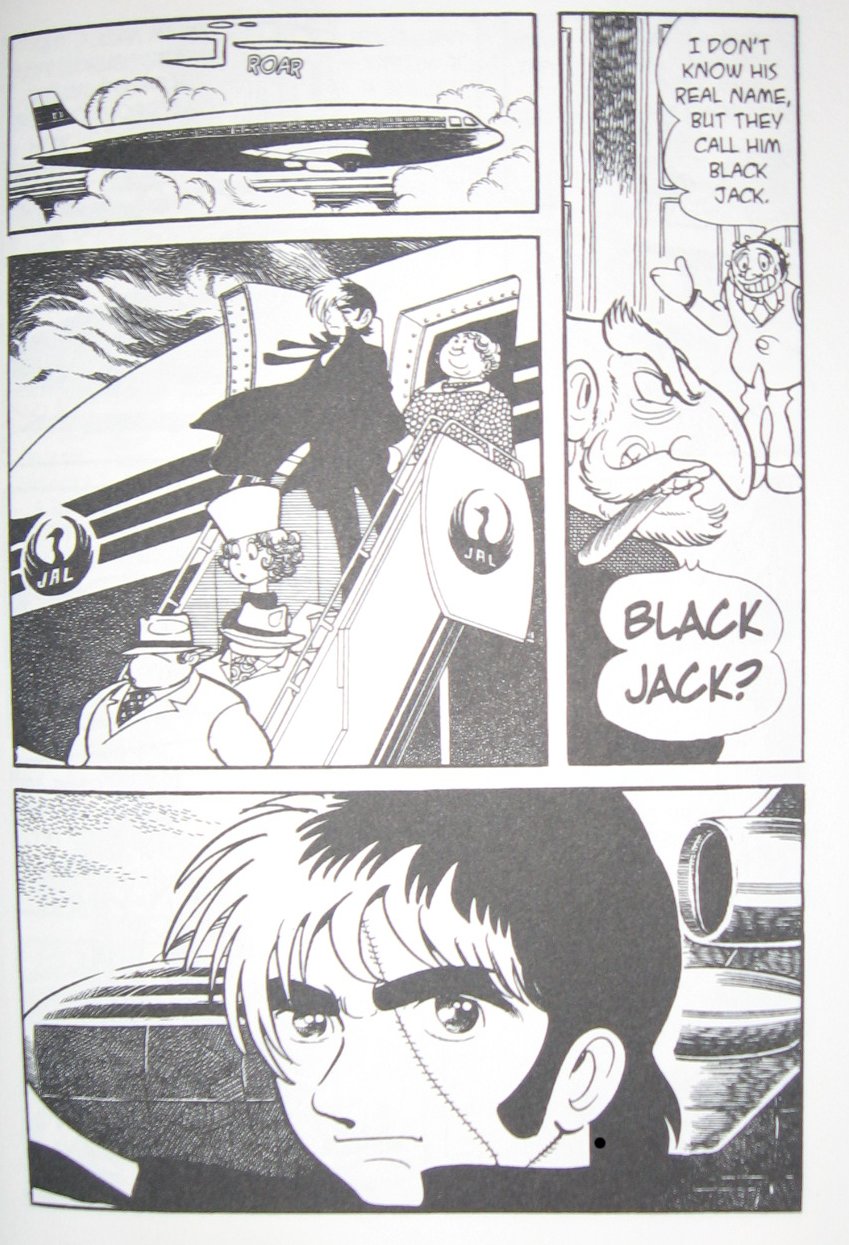
And now, a photo of a postcard showing Tezuka's original art from the same page:
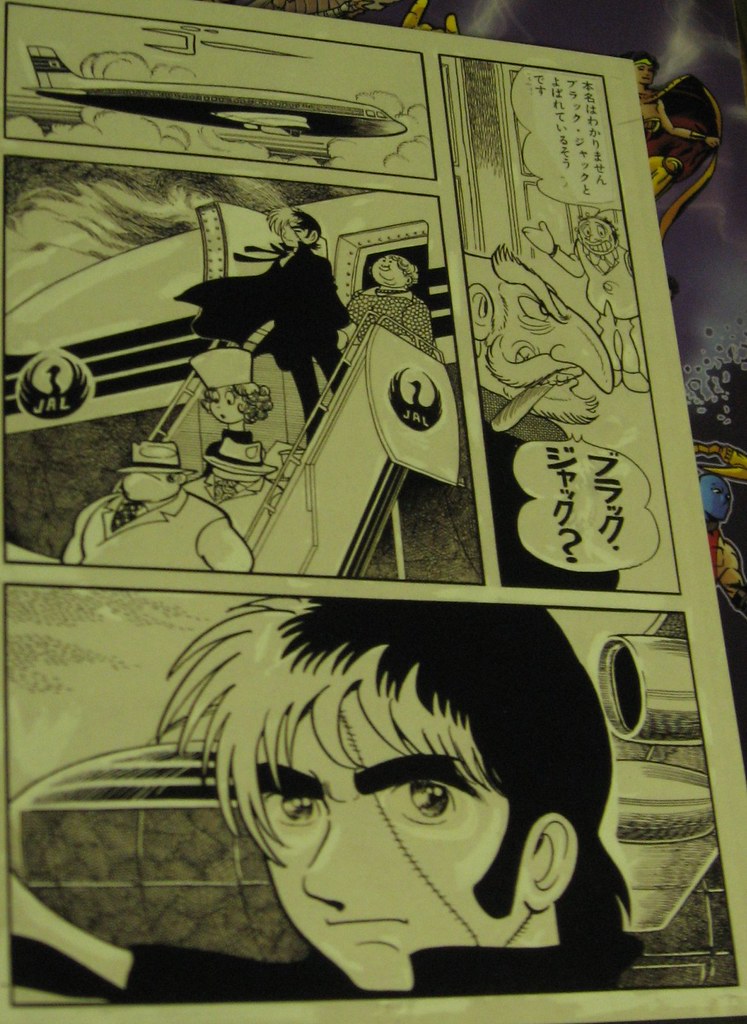
Check out those corrections! And the amount of detail totally lost in the Viz version.
I went back and forth on which translation I preferred, but the lettering on that page of the Vertical one is waaaay better.
Also of interest here are a couple of other pages (without Tezuka originals).
Viz:
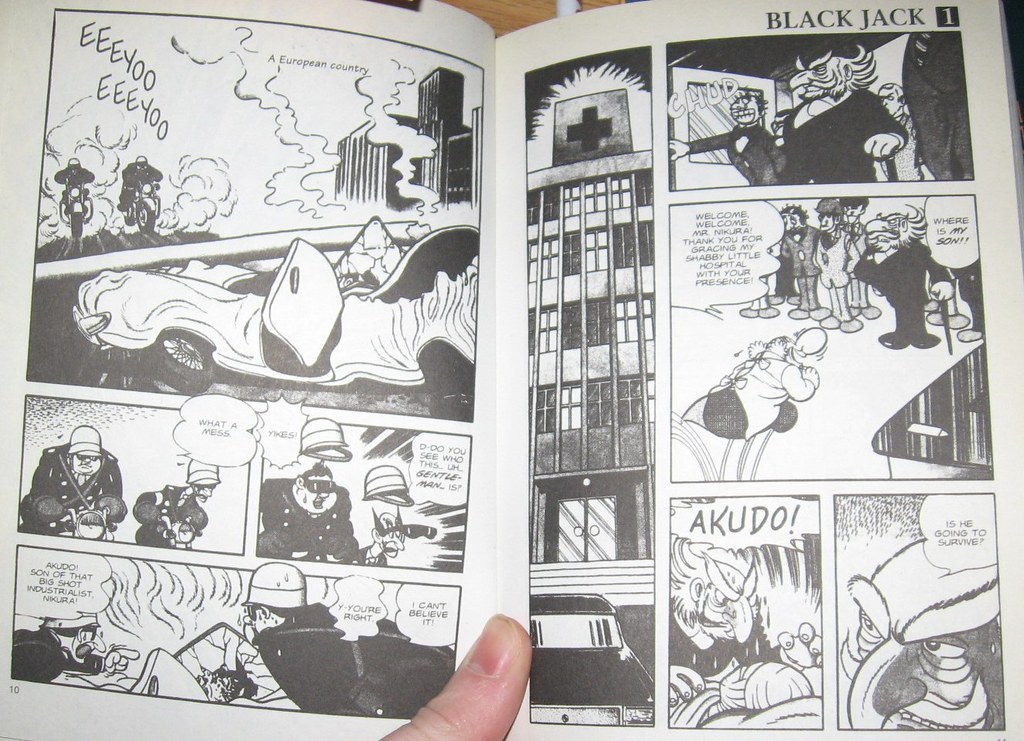
Vertical:
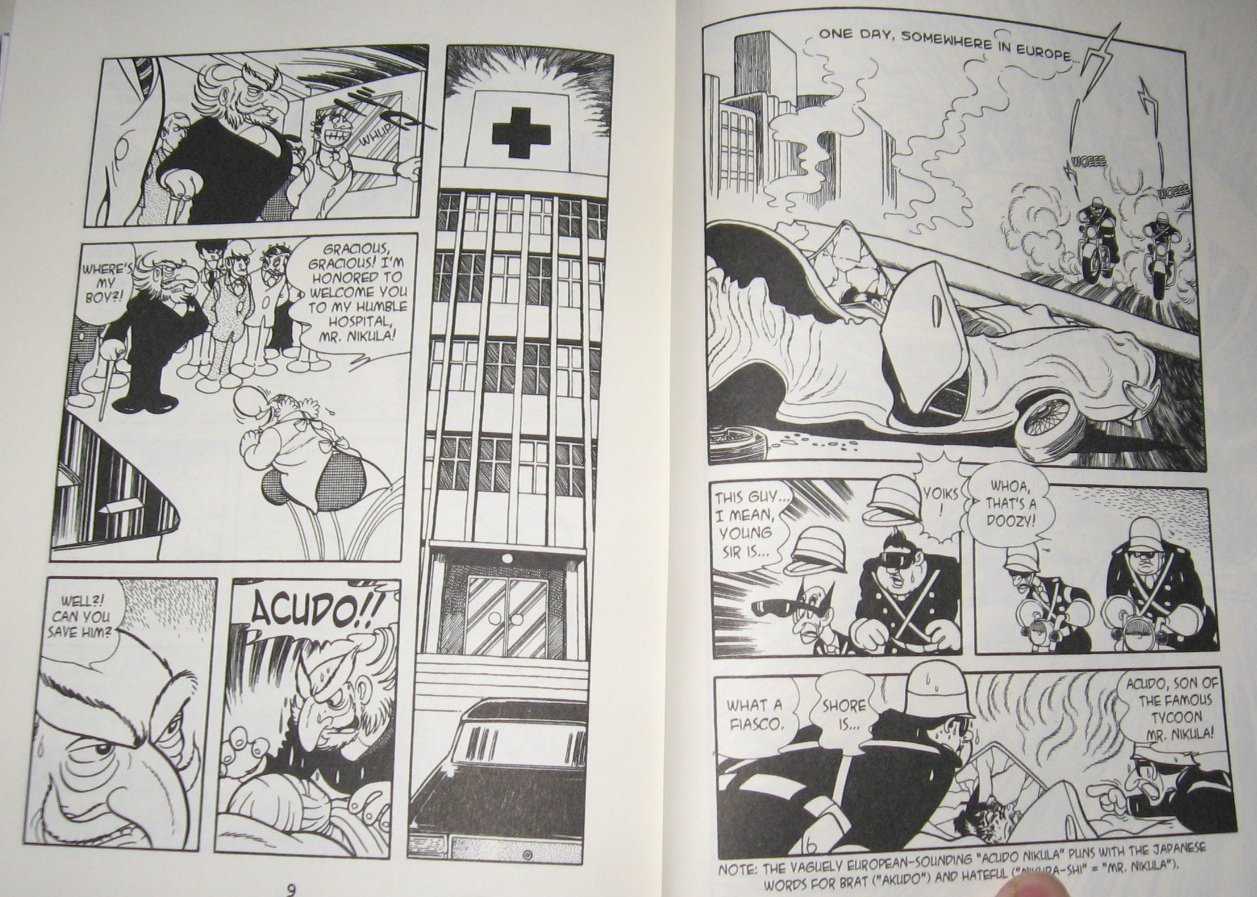
What you should be able to notice here, despite the terrible image quality, is the large amount of gray shading in the Viz edition that isn't evident at all in the Vertical edition, leading me to assume the Viz version was printed from a colourized version. Ooooh.
And speaking of colour Tezuka, I recently got an awesome set of postcards reprinting covers to a bunch of his early work. Here's a bit of a preview, I'll try and post more later.

Oh Tezuka!
Monday, March 16, 2009
Banya the Explosive Delivery Man

This was written for Jeju Life, but I didn't even submit it, or even finish it really, after they didn't run the other review I wrote for them.
Fast. Precise. Secure.
Banya the Explosive Delivery Man
By Kim Young Oh
Five volumes from Dark Horse
$12.95US
While the title may lead you to think this series features mail carriers blowing up dogs, Banya is actually about a delivery person in the fictional Gaya desert. Though the act of Banya delivering things is really only there to allow him to encounter people he has to fight.
The first few volumes are Banya, and the other delivery people, Mei and Kong, just delivering things and fighting people.
Volumes four and five are when a plot more indepth than "get this thing to this location" kicks in and we start getting some of Banya's backstory. To be honest I liked these two books less than the first three. Mei and Kong are written out (to "protect" them, oh Banya), and we're introduced (or reintroduced) to some other characters: the evil guy who's trying to take over/destroy the world by gaining control of a dragon, the female summoner monk from earlier in the series who is trying to stop this, and a big strong guy who has a talking sword.
I would have prefered it if Banya had just continued making deliveries as more of his history was revealed. What I would have really liked to see was a story where Banya is delivering something for the "bad guys" and heroes are trying to stop him, but while he knows it's wrong, he feels he must deliver it anyway. Perhaps that will show up in the next comic I read about delivery people.
Despite my disinterest in the plot of the last two volumes, the art still holds up and you get some nice action fight scenes between more of the ugly, ugly villians. Plus it's translated by Derek Kirk Kim, indie comics superstar. Go read his comic "Same Difference and Other Short Stories."
Monday, March 09, 2009
Goong (궁)

Originally published in the January 2007 issue of The Ulsan Pear (you can find issues in pdf format at ulsanonline.com).
Che Kyung Shin was just a normal high school girl, but now she’s learning just how much being a princess sucks. Every day is scheduled down to the last minute, she can’t live with (or even see) her family anymore and her husband (the crown prince) is a jerk.
So Hee Park’s Goong is set in a world were Korea still has a royal family and operates as a constitutional monarchy. The royal family are absurdly popular with the general public, despite, or perhaps because of, their extreme ties to tradition. So when Shin Lee, the crown price or “seja,”
starts going to Che’s school, she’s excited. Until she actually talks to him and discovers he’s a jerk who she wants nothing to do with.
Unfortunately, things don’t go that way. It turns out that Che’s grandfather was best friends with the prince’s grandfather (the former king) and before the king died they decided that their grandchildren (Che and Shin) would marry. In the twenty-first century it seems unlikely that you could convince two teenagers, especially ones that don’t like each other, that they should get married, yet in volume two they do. So what happened?
At first Che is going to say no, but having her mother prodding her towards marriage because she would rather have her daughter be unhappy for the rest of her life than her father-in-law feel guilty, doesn’t exactly help. But when Che realizes that this could be a way for her family to escape the poverty they live in, she relents. She is willing to sacrifice herself for her family.
However, Shin’s motivations are nowhere near as self-sacrificing. The prince thinks Che is a clutz and a fool and only agreed to marry her because he knows the life of a princess is horrible. “Do you think I’m crazy enough to make the one that I love be forced to live in the palace like a doll? Since I don’t care what happens to you, I am letting you be sejabin [crown princess].” He also says that later, when things get really horrible, he’ll just divorce her. How nice!
At this point you can pretty much figure out this isn’t the start to a typical romance story.
It is, however, funny and mostly undercuts things expected from this type of comic. At times a page will show what will happen in normal romance comics, and then the next page will have what actually happens in Goong (usually featuring characters doing something stupid).
The art is heavily influenced by Japanese comics (as are most Korean comics), but it looks good
and works well with the story (a lot of effort has been put into making the characters’ clothes look fashionable). At times it becomes super-deformed, which is strange the first time you see it, but is part of this artistic style.
Romance stories aren’t really my thing, but Goong is good and different enough to pull me in. Will Che fall in love with Shin (don’t do it, he’s not worth it!) or will she end up with his brother who seems nice (yes!) but may be too good to be true?
Goong is one of the most popular comics currently being made in Korea, and has also been made into a TV drama. If you want to brush up on your Korean, you can pick up the graphic novels easily enough. Thankfully, it’s also now available in English, just check amazon or somewhere.
Tuesday, February 17, 2009
Laya, Witch of the Red Pooh

[I wrote this for jejulife, but they never ran it.]
Art and story by Yo Yo
Published by Tokyopop (English, two volumes) In Korea it appeared in Young Champ magazine.
Korea may be full of comic books, but it can seem like all of them are just translated imports from Japan. So where are the Korean comics? Thankfully it recent years a variety of publishers have been releasing Korean comics (Manhwa) in English, so now you can find out what the country has to offer.
After reading Laya, Witch of the Red Pooh I really wished that there was magic in the world again. I wished that I could have a friend who could cast magic spells and make magic potions and let me stay at her house indefinitely after I burnt mine down. I wished I could do magic myself, but I'd probably be just as lazy as Laya.
Laya is a witch; not a wizened old crone as usually seen in Western stories, but (as you probably already know from the cover) a young, cute witch. She's also very lazy, with still lazier friends who hang around her house distracting her from getting her job done.
Laya's friends include Puss, her cat who talks, walks around in boots, and is constantly smoking or drinking when he's not sleeping. Snowy the Crow, who has to stay in the form of a cute boy or Laya will kick him out. And Niky, another witch who can't go home because she burnt her house down.
The stories are pretty silly, and usually about Laya procrastinating doing witch work like making magic potions, trying to use magic to make her life easier, or the characters being incompetent in some way or another. Each story is only about four pages long, but a surprising amount can happen in those pages, and each character's personalities really come across well despite the limited space.
Most of the humour is pretty understandable without any knowledge of Korea, though the occasional joke my go over your head if you don't know anything about the country. (You might wonder what the name Digo Re is funny, until you realize they meant "Re" to be the family name, not the last name.)*
The artwork varies quite a lot; the best stuff being nice and detailed, with lots of work put into designing the clothes the characters are wearing and the backgrounds. Then there's the sorta super deformed stuff, and at the bottom is the rather poorly drawn stuff that seems to have been drawn when the artist was horribly behind on deadlines. Yet the occasionally bad art doesn't detract from the comic itself, instead it (somehow) still manages to be enjoyable.
While all the dialogue in the Tokyopop edition is in English, the sound effects have been left untranslated, allowing you to practice your Korean alphabet, or completely ignore them as the case may be.
At around 120-30 pages both books are a bit shorter than your average comic from Tokyopop, but both are still totally worth picking up if you're in the mood for something cute and funny.
*Re Digo = ready go.
Saturday, January 10, 2009
Comics World Busan
After I stopped updating this blog, I wrote a few articles and reviews for some magazines in Korea. Some of them were printed, some weren't. None of them are online now, so I might as well post them here.
Comic World Busan
Originally printed April, 2006 in The Ulsan Pear (you can find issues in pdf format at ulsanonline.com).
On March 25th I attended Comic World 32 at BEXCO in Busan, Korea. I had no idea what to expect. When I arrived outside the convention hall the first thing I saw were tons of people, and tons of cosplayers.
Cosplay is the Japanese (and Korean) word for dressing up as a character from a comic, cartoon or videogame. People put a lot of work into their costumes and friends will all dress up as characters from the same story so you’ll see gangs of people in weird clothing walking around together. They hang around outside and pose whenever people want to take their photos, and there are tons of people taking photos.
Inside the BEXCO building was quite different from outside, and a bit disappointing too. The large hall that contained everything wasn’t the nicest looking, but that doesn’t really matter that much. There were several rows of tables with dozens of booths set up in them.
Each booth contained not the piles of back-issues you might expect, nor did it feature any hot artists of popular comics, not even piles of mini-comics made by local creators. Instead, looking at what was offered at the booths, it was clear that this was a fan convention.
The booths had merchandise that featured characters from popular comics; usually badges, stickers, art prints, bags, cards, cell phone danglies and dōjinshi.
Well, not actually dōjinshi, that’s a Japanese word. Dōjinshi are usually fan comics. They’re fanfiction taken to the extreme. A fan will read a comic and like it a lot and decide to draw, publish and sell their own adventures of the characters.
The comics themselves are beautifully produced. Square bound and slightly larger than the usual American sized comics. They also usually have covers, and sometimes a few interior pages, in colour. The art is generally pretty good, though it probably won’t look exactly like the characters do in the comic. Also, because Korean reads left to right these comics read in the familiar direction instead of “backwards” like most Japanese comics.
Dōjinshi creators usually produce their comics in low print runs to avoid the chances of them getting sued (they are using other peoples characters after all). So if you see something cool, pick it up, you might not get another chance. A number of comic creators started by making dōjinshi before becoming famous, so maybe that neat looking comic was drawn by someone who’ll become famous.
Interestingly, the costumes, comics and other merchandise seen at Comic World really showed that the most popular comics in Korea are Japanese ones. Naruto, One Piece, Death Note, Full Metal Alchemist, Inu Yasha, Kerero (Sergeant Frog) and Gundamn were all clearly visible at the event and are all popular, or at least available, in English.
The Comic World Busan events happen fairly regularly, with the next one happening on May 27th and 28 th. I only know one thing for sure, next time I go to one of these things I’ll be in costume too. Now all I need to do is learn Korean so I can actually read these comics.
Visit the Comic World website at www.comicw.co.kr (in Korean).
Comic World Busan
Originally printed April, 2006 in The Ulsan Pear (you can find issues in pdf format at ulsanonline.com).
On March 25th I attended Comic World 32 at BEXCO in Busan, Korea. I had no idea what to expect. When I arrived outside the convention hall the first thing I saw were tons of people, and tons of cosplayers.
Cosplay is the Japanese (and Korean) word for dressing up as a character from a comic, cartoon or videogame. People put a lot of work into their costumes and friends will all dress up as characters from the same story so you’ll see gangs of people in weird clothing walking around together. They hang around outside and pose whenever people want to take their photos, and there are tons of people taking photos.
Inside the BEXCO building was quite different from outside, and a bit disappointing too. The large hall that contained everything wasn’t the nicest looking, but that doesn’t really matter that much. There were several rows of tables with dozens of booths set up in them.
Each booth contained not the piles of back-issues you might expect, nor did it feature any hot artists of popular comics, not even piles of mini-comics made by local creators. Instead, looking at what was offered at the booths, it was clear that this was a fan convention.
The booths had merchandise that featured characters from popular comics; usually badges, stickers, art prints, bags, cards, cell phone danglies and dōjinshi.
Well, not actually dōjinshi, that’s a Japanese word. Dōjinshi are usually fan comics. They’re fanfiction taken to the extreme. A fan will read a comic and like it a lot and decide to draw, publish and sell their own adventures of the characters.
The comics themselves are beautifully produced. Square bound and slightly larger than the usual American sized comics. They also usually have covers, and sometimes a few interior pages, in colour. The art is generally pretty good, though it probably won’t look exactly like the characters do in the comic. Also, because Korean reads left to right these comics read in the familiar direction instead of “backwards” like most Japanese comics.
Dōjinshi creators usually produce their comics in low print runs to avoid the chances of them getting sued (they are using other peoples characters after all). So if you see something cool, pick it up, you might not get another chance. A number of comic creators started by making dōjinshi before becoming famous, so maybe that neat looking comic was drawn by someone who’ll become famous.
Interestingly, the costumes, comics and other merchandise seen at Comic World really showed that the most popular comics in Korea are Japanese ones. Naruto, One Piece, Death Note, Full Metal Alchemist, Inu Yasha, Kerero (Sergeant Frog) and Gundamn were all clearly visible at the event and are all popular, or at least available, in English.
The Comic World Busan events happen fairly regularly, with the next one happening on May 27th and 28 th. I only know one thing for sure, next time I go to one of these things I’ll be in costume too. Now all I need to do is learn Korean so I can actually read these comics.
Visit the Comic World website at www.comicw.co.kr (in Korean).
Friday, January 09, 2009
Club 9
As last year I published a grand total of nothing (well, I made a zine), I decided that this year in celebration of having an article published I should at least write reviews of stuff on a blog again. Nobody will read it, but at least it'll keep me writing. I can't believe how much I used to write for here.
First up, Club 9.

I picked up the first volume of this from the library (this will be a recurring theme as libraries are awesome!) because I had a total brain failure and thought for some reason it was by the same creator as Flowers and Bees (that's Moyocco Anno for those who don't know). I read the first volume of Flowers and Bees last year, and enjoyed it, but hadn't had a chance to read any more, so I figured I'd check this one out.
Of course it's not by her, but that doesn't make it any less good. The actual creator is Makoto Kobayashi, possible "best" known in North America for What's Michael?, his comic about cats being incredibly cute (and weird). It is, as far as I know, mostly out of print at the moment, which is a shame, as it's fantastic.
Anyway, Club 9 is about Haruo Hattori, a klutzy, naive girl who's just moved to Tokyo to go to university, and ends up working at a hostess bar. Of course you wouldn't know that from the first chapter, which is mostly about her high school baseball team winning the national championships, and their star pitcher not getting picked in the draft. Sure Hauro shows up (falling into a cesspit and then accidentally flashing all her classmates), but if not for the text on the last page, you could be forgiven for not knowing who this comic was supposed to be about.
Hell, even the next several chapters don't tell what the comic is "really" about. Instead we're introduced to Haruo (kind, clumsy) and her family (her father is stern, her mom is going crazy because she doesn't want to turn 40) before she leaves for Tokyo. Once there she befriends several other girls,and ends up in a dorm room haunted by a lecherous ghost (Kobayashi clearly isn't afraid of including completely fantastical elements in his stories). Eventually we get to the point where she moves out and she gets a job at a hostess club to pay rent.
For those of you that don't know, a hostess club is a type of bar, common in Asia, where men pay women to drink and talk with them. Generally that's all that happens, the men drink and talk with pretty girls, and they pay a whole lot of money to be able to do so.
At first Haruo doesn't seem cut out for the job; she gets lost on her way to the club, shows up without makeup and in clothes that leave the owner aghast, and manages to set a client's mustache on fire while trying to light his cigarette.
Despite this, she ends up doing well, as she's the type of person who can talk to anyone. She soon relaxes, and the men at the Club 9 bar (including one called Makoto Konbayashi, creator of the What's Bear? manga about an incredibly cute dog...), are all incredibly charmed by her Southern accent and mannerisms. Or whatever the Japanese equivalent is I suppose (the Akita dialect?).
This is one place where the translation is rather odd. It's an an example of how complicated translation can be; how do you express accents from another country that don't have any equivalent in English? Haruo (and everyone from her hometown) talks in thick Southern US accents. Haruo is supposed to be a hick, from small town Japan, and sound unsophisticated, so I suppose the accent used is one that most English speakers could understand. It's still a bit odd at first though.
By the end of volume one Haruo seems somewhat settled, and I assume the rest of the series continues to be about Haruo juggling being a "Ginza girl" (albeit, an incredibly clumsy one), being a student, and trying to stay a virgin for her boyfriend (the star baseball pitcher from her high school) back home. But for all I know it goes off in some other direction and the murderer at the beginning of chapter 3 shows up. No matter what does happen, I'm sure it'll be good.
Unfortunately, this comic never really caught on in North America. And while Dark Horse did at least finish translating it in Super Manga Blast, they only put out three or four of the five volumes. I had a coworker at a comic book shop I used to work at that really liked this series, going so far as trying to track down those last issues of SMB to try and find out how it ended. I don't think she was that successful.
Perhaps one of the reasons this series didn't really catch on is Kobayashi's art. I certainly enjoy it, but I can understand how the giant mouths everyone has and the giant eyes Haruo has could be off putting. While not "standard manga," they really help Kobayashi show the characters emotions, which he does extremely well. Yes, they're incredibly exaggerated, but you know exactly how the characters are feeling.
It's too bad Kobayashi's comics haven't been more popular in North America, as I wouldn't mind reading one called Chichonmanchi, about a woman who dies at 92, and is all ready to go to paradise, but! She's still a virgin, so she gets given a new, young body, and is sent off to "pleasure hell" until she has sex. Apparently there's not that much actual sex in the comic, even if there is a lot of nudity. There's some more information about it here.
First up, Club 9.
I picked up the first volume of this from the library (this will be a recurring theme as libraries are awesome!) because I had a total brain failure and thought for some reason it was by the same creator as Flowers and Bees (that's Moyocco Anno for those who don't know). I read the first volume of Flowers and Bees last year, and enjoyed it, but hadn't had a chance to read any more, so I figured I'd check this one out.
Of course it's not by her, but that doesn't make it any less good. The actual creator is Makoto Kobayashi, possible "best" known in North America for What's Michael?, his comic about cats being incredibly cute (and weird). It is, as far as I know, mostly out of print at the moment, which is a shame, as it's fantastic.
Anyway, Club 9 is about Haruo Hattori, a klutzy, naive girl who's just moved to Tokyo to go to university, and ends up working at a hostess bar. Of course you wouldn't know that from the first chapter, which is mostly about her high school baseball team winning the national championships, and their star pitcher not getting picked in the draft. Sure Hauro shows up (falling into a cesspit and then accidentally flashing all her classmates), but if not for the text on the last page, you could be forgiven for not knowing who this comic was supposed to be about.
Hell, even the next several chapters don't tell what the comic is "really" about. Instead we're introduced to Haruo (kind, clumsy) and her family (her father is stern, her mom is going crazy because she doesn't want to turn 40) before she leaves for Tokyo. Once there she befriends several other girls,and ends up in a dorm room haunted by a lecherous ghost (Kobayashi clearly isn't afraid of including completely fantastical elements in his stories). Eventually we get to the point where she moves out and she gets a job at a hostess club to pay rent.
For those of you that don't know, a hostess club is a type of bar, common in Asia, where men pay women to drink and talk with them. Generally that's all that happens, the men drink and talk with pretty girls, and they pay a whole lot of money to be able to do so.
At first Haruo doesn't seem cut out for the job; she gets lost on her way to the club, shows up without makeup and in clothes that leave the owner aghast, and manages to set a client's mustache on fire while trying to light his cigarette.
Despite this, she ends up doing well, as she's the type of person who can talk to anyone. She soon relaxes, and the men at the Club 9 bar (including one called Makoto Konbayashi, creator of the What's Bear? manga about an incredibly cute dog...), are all incredibly charmed by her Southern accent and mannerisms. Or whatever the Japanese equivalent is I suppose (the Akita dialect?).
This is one place where the translation is rather odd. It's an an example of how complicated translation can be; how do you express accents from another country that don't have any equivalent in English? Haruo (and everyone from her hometown) talks in thick Southern US accents. Haruo is supposed to be a hick, from small town Japan, and sound unsophisticated, so I suppose the accent used is one that most English speakers could understand. It's still a bit odd at first though.
By the end of volume one Haruo seems somewhat settled, and I assume the rest of the series continues to be about Haruo juggling being a "Ginza girl" (albeit, an incredibly clumsy one), being a student, and trying to stay a virgin for her boyfriend (the star baseball pitcher from her high school) back home. But for all I know it goes off in some other direction and the murderer at the beginning of chapter 3 shows up. No matter what does happen, I'm sure it'll be good.
Unfortunately, this comic never really caught on in North America. And while Dark Horse did at least finish translating it in Super Manga Blast, they only put out three or four of the five volumes. I had a coworker at a comic book shop I used to work at that really liked this series, going so far as trying to track down those last issues of SMB to try and find out how it ended. I don't think she was that successful.
Perhaps one of the reasons this series didn't really catch on is Kobayashi's art. I certainly enjoy it, but I can understand how the giant mouths everyone has and the giant eyes Haruo has could be off putting. While not "standard manga," they really help Kobayashi show the characters emotions, which he does extremely well. Yes, they're incredibly exaggerated, but you know exactly how the characters are feeling.
It's too bad Kobayashi's comics haven't been more popular in North America, as I wouldn't mind reading one called Chichonmanchi, about a woman who dies at 92, and is all ready to go to paradise, but! She's still a virgin, so she gets given a new, young body, and is sent off to "pleasure hell" until she has sex. Apparently there's not that much actual sex in the comic, even if there is a lot of nudity. There's some more information about it here.
Saturday, January 07, 2006
Sekai Trilogy: Crest of the Stars and Planetes
Seikai Trilogy vol. 1: Crest of the Stars
Original Story by Hiroyuki Morioka
Composition by Aya Youshinaga
Art by Toshihiro Ono
Published by Tokyopop
Planetes vols. 3, 4.1 and 4.2
By Makoto Yukimura
Published by Tokyopop
It’s taken me a while to write this one as I had to read four different graphic novels. Plus, you know, being late is procrastislicious.
So here’s reviews of two Japanese science fiction comics. Sekai Trilogy seems to be more space opera-y, while Planetes is more hard sci fi-y. (They’re both good though.)
Sekai Trilogy is interesting if only because as opposed to most manga, or at least most manga published in North America, it isn’t an original idea, nor is it based on a cartoon. Instead it is an adaptation of a series of novels. There’s also an anime adaptation of the novels which I think, though I’m not positive, came first, influencing the character designs for this book.
As Crest of the Stars begins the Abh, a race of genetically engineered humans, have just taken over the Hyde star system. Jinto’s father was the ruler of the system and has surrendered instead of fighting the far superior Abh. By giving up total autonomous rule in this way Jinto and his father become Abh themselves, not in the genetically modified sense, but in regards to their status and positions. Jinto then finds himself sent off to boarding school for his own protection. The people of his homeworld now hate him and his father
Seven years later and Jinto is heading off to Abh officer school. He’s picked up at the spaceport by Lafiel, a girl who at first seems to have major personality problems. Jinto is brought up to the ship he’ll be travelling through space on and discovers the weird girl is actually a princess. After ignoring his Abh “heritage” for years, Jinto is probably the only person around who couldn’t identify her. This pleases her greatly as he’s the only one who doesn’t treat her like, well, a princess, while all she wants is to be treated according to her (not very high) military rank.
There’s soon a big space battle (a war has been declared) and Jinto and Lafiel are jettisoned out so that they don’t die horribly in space. Jinto is rather happy about this, but Lafiel, rightly, believes that she’s being given custody of Jinto to get her out of harms way. Nobody, even after they’ve died in a horrible space battle, wants to be blamed for killing the princess.
Jinto and Lafiel then spend a while trying to get somewhere where they can tell people they’re not dead. They visit a tiny kingdom on an asteroid (complete with semi-pointless fanservice) and a planet now under enemy control. There’s a lot of running around and disguises and cultural misunderstanding. Eventually they hook up with a rebel faction that doesn’t like the Abh empire, but also doesn’t like their enemy. It’s honestly better then I’m making it sound.
The art is nothing special really, though I suppose the artist was restricted by having to use the designs for the characters and vehicles that were created in the cartoon. Still, it tells the story effectively and is never actually bad.
One of the downfalls of the Sekai Trilogy is the huge amount of made up words in it. Now I expect a certain amount of made up words in any book I read, and you’ll catch on to some right away, and a few others after a while, but with the sheer number in this book I couldn’t get them all. There’s over one hundred listed in the glossary in the back, and I’m pretty sure it didn’t get them all. (The glossary itself is a mixed blessing because you keep flipping to the back and trying to find words. It really interrupts the flow of the story.)
So what’s the deal with all the fake words? Apparently Hiroyuki Morioka, who wrote the original novels, is a big fan of constructed languages. I think that in some cases this can be used pretty well. You can create words to express things that can’t be expressed in English (or Japanese or whatever). It can reflect differences in society. But why create a new word for car (usiya)? Or roses (bara)? Or others. It just doesn’t really make sense to me…
The language is however just one facet of the entire world (or worlds) that have been created here. The other comics, cartoons and books probably help flesh them out even more, and I’m interested enough to go looking for them (maybe I’ll even pick up a bit more of the language!).
Okay, now for the next sci-fi comic from Japan.
Planetes is set in the 2070s. Humankind has reached beyond the bounds of Earth. There are colonies on the Moon and Mars and piles of astronauts and spaceships going into space all the time. (It also seems to be a fully, awesomely, multicultural society. The main characters come from countries all over the world and of different ethnicities. Russian, Japanese, American, English. Black, white, Asian. It’s a world where these things don’t matter.)
Volume one of Planetes followed the debris collection spaceship Toybox and it’s crew of Fee, Hachimaki and Yuri. The stories were about the group as a whole and the members individually. Volume two was about Hachimaki and his attempts to become one of the crew of the first manned spaceship being sent to Jupiter.
Volume three continues to focus on Hachimaki as he trains and prepares for the upcoming mission to Jupiter. And by “prepare” I mean “goes insane.” Despite this being everything Hachimaki’s dreamed of he doesn’t really seem to be able to deal with it. He keeps blanking out and almost dies after a strange “vision quest” thing on the surface of the moon. His crewmates for the mission worry about this, some because they don’t want something bad to happen to him, and some because they don’t want to deal with a nutcase on a seven year mission to Jupiter. (Which is, you know, understandable.)
Tanabe, the replacement for Hachimaki onboard the Toybox, also gets feature fairly prominently in this volume. We learn about her past (her adoptive father is an aging rocker with an inverted cross tattooed on his face, awesome!) and about her and what she thinks and feels.
Volumes 4.1 and 4.2 again focus on Fee and Yuri as Hachimaki is off on his seven year voyage. I think I prefer these stories of…working class astronauts and how they deal with their lives and their families to the big awesome space project. About people trying to do their job for themselves and their families. Trying to do their best to stop the stupidity of space war in whatever small way they can. The characters try to figure out who they are and what they stand for.
The stories at time have a dreamlike quality to them. Maybe. They seem slow moving. Both meandering and purposeful (even when they feature explosions). The characters act like, well, possibly how I would act if I lived in the future. I love space and space exploration. I think it’s really cool. I wish everyday that I could go up there at some point. I would jump at the chance to be a garbage collector in space.
The problem is that I’m both a slacker and a pessimist. Could I become an astronaut? The possibility does exist, I’m young, fairly intelligent and pretty healthy. I could go back to university, get engineering and science degrees, master Russian, join the air force (or something) and get flight training. I could do it all.
But…the pessimism. Even if I did this I don’t think I’d cut it. I’d do something that would get me cut from the running to be an astronaut. Either I wouldn’t be good enough or my morals and ethics wouldn’t allow me to do something. Something. If I was promised a place in space would I do it? Would I drop everything and spend ten years (or more) studying and training and everything? I don’t know. I think so. Maybe I’d be too scared to do so. Maybe I’m not tough enough to do it.
Not good enough.
This is what Planetes does to me. It makes me think. It makes me hopeful. It makes me sad.
(This review sucks.)
The art in Planetes is really good too. Makoto Yukimura manages to capture the grandeur and the emptiness of space. The loneliness and the silence. These comics sound quiet to me. When they’re in space (where there is no sound) I sometimes have a hard time playing music because I don’t think I should hear anything either. The characters emotions are also captured beautifully and you’re able to tell what they’re thinking and what they’re feeling.
Volume three has a beautiful cover that reminds me of Russian science fiction movies (like Solaris and this weird soviet cartoon).
(Click for cover.)
Volumes 4.1 and 4.2 have had a lot of care put into their production. As you may know many manga have their first few pages printed in painted colour (sometimes when a new storyline stars they’ll get another few pages in colour). Usually when these are collected they turned to gray tones and you get a few pages that look odd. Sometimes you’ll get the colour pages bound in at the beginning of the volume, but not always.
With Planetes 4.1 and 4.2 you not only have the colour stuff bound at the beginning of the volume, but bound throughout the book, wherever it appeared. Okay, so admittedly the colours don’t look that good (though whether that’s down to reproduction or the original colours I don’t know), but nonetheless it’s a cool thing to do.
The backs of 4.1 and 4.2 also have piles of text material. This is partially to bulk up the pagecount (4.1 is only about 160 pages, while 4.2 doesn’t hit 180), but also because the likelihood of Tokyopop reprinting the text book talking about science and history from now until the 2070s is pretty slim. (Hell, I wouldn’t even buy it.) I guess they might as well print some of it somewhere.
(Why are they numbered 4.1 and 4.2? Well that’s how they’re numbered in Japan. And there’s the possibility that the author will come back and do a new volume. It seems sort of unlikely though, as while the ending is incredibly open (to the point of not really resolving everything/anything) he’s working on another comic now. About a viking.)
Planetes got a fair number of reviews with its first volume. A hard sci-fi comic about garbage collectors in Earth orbit is not what most people expect from manga. The second volume received a fair amount of backlash as it changed tack slightly. I still liked it, and I like these volumes as well. Though I don’t think they’re as strong as that first volume.
I honestly can’t say I was expecting much from Crest of the Stars, but I was pleasantly surprised. Apart from a bit of fan service it was a pretty solid Sci-Fi comic. Not as good as Planetes, but still pretty good and I’m interested in reading more.
Planetes on the other hand is just so good. I wish I had the first two volumes here so that I could reread them. Even though I don’t think these volumes stand up as well as the first two they’re still excellent comics. Thoughtful and thought provoking. Full of science and dreams. (I could only wish this was my life.) It’s realistic science fiction (with an emphasis on the science part) that is more about the people then the world they inhabit and the technology they use.
Original Story by Hiroyuki Morioka
Composition by Aya Youshinaga
Art by Toshihiro Ono
Published by Tokyopop
Planetes vols. 3, 4.1 and 4.2
By Makoto Yukimura
Published by Tokyopop
It’s taken me a while to write this one as I had to read four different graphic novels. Plus, you know, being late is procrastislicious.
So here’s reviews of two Japanese science fiction comics. Sekai Trilogy seems to be more space opera-y, while Planetes is more hard sci fi-y. (They’re both good though.)
Sekai Trilogy is interesting if only because as opposed to most manga, or at least most manga published in North America, it isn’t an original idea, nor is it based on a cartoon. Instead it is an adaptation of a series of novels. There’s also an anime adaptation of the novels which I think, though I’m not positive, came first, influencing the character designs for this book.
As Crest of the Stars begins the Abh, a race of genetically engineered humans, have just taken over the Hyde star system. Jinto’s father was the ruler of the system and has surrendered instead of fighting the far superior Abh. By giving up total autonomous rule in this way Jinto and his father become Abh themselves, not in the genetically modified sense, but in regards to their status and positions. Jinto then finds himself sent off to boarding school for his own protection. The people of his homeworld now hate him and his father
Seven years later and Jinto is heading off to Abh officer school. He’s picked up at the spaceport by Lafiel, a girl who at first seems to have major personality problems. Jinto is brought up to the ship he’ll be travelling through space on and discovers the weird girl is actually a princess. After ignoring his Abh “heritage” for years, Jinto is probably the only person around who couldn’t identify her. This pleases her greatly as he’s the only one who doesn’t treat her like, well, a princess, while all she wants is to be treated according to her (not very high) military rank.
There’s soon a big space battle (a war has been declared) and Jinto and Lafiel are jettisoned out so that they don’t die horribly in space. Jinto is rather happy about this, but Lafiel, rightly, believes that she’s being given custody of Jinto to get her out of harms way. Nobody, even after they’ve died in a horrible space battle, wants to be blamed for killing the princess.
Jinto and Lafiel then spend a while trying to get somewhere where they can tell people they’re not dead. They visit a tiny kingdom on an asteroid (complete with semi-pointless fanservice) and a planet now under enemy control. There’s a lot of running around and disguises and cultural misunderstanding. Eventually they hook up with a rebel faction that doesn’t like the Abh empire, but also doesn’t like their enemy. It’s honestly better then I’m making it sound.
The art is nothing special really, though I suppose the artist was restricted by having to use the designs for the characters and vehicles that were created in the cartoon. Still, it tells the story effectively and is never actually bad.
One of the downfalls of the Sekai Trilogy is the huge amount of made up words in it. Now I expect a certain amount of made up words in any book I read, and you’ll catch on to some right away, and a few others after a while, but with the sheer number in this book I couldn’t get them all. There’s over one hundred listed in the glossary in the back, and I’m pretty sure it didn’t get them all. (The glossary itself is a mixed blessing because you keep flipping to the back and trying to find words. It really interrupts the flow of the story.)
So what’s the deal with all the fake words? Apparently Hiroyuki Morioka, who wrote the original novels, is a big fan of constructed languages. I think that in some cases this can be used pretty well. You can create words to express things that can’t be expressed in English (or Japanese or whatever). It can reflect differences in society. But why create a new word for car (usiya)? Or roses (bara)? Or others. It just doesn’t really make sense to me…
The language is however just one facet of the entire world (or worlds) that have been created here. The other comics, cartoons and books probably help flesh them out even more, and I’m interested enough to go looking for them (maybe I’ll even pick up a bit more of the language!).
Okay, now for the next sci-fi comic from Japan.
Planetes is set in the 2070s. Humankind has reached beyond the bounds of Earth. There are colonies on the Moon and Mars and piles of astronauts and spaceships going into space all the time. (It also seems to be a fully, awesomely, multicultural society. The main characters come from countries all over the world and of different ethnicities. Russian, Japanese, American, English. Black, white, Asian. It’s a world where these things don’t matter.)
Volume one of Planetes followed the debris collection spaceship Toybox and it’s crew of Fee, Hachimaki and Yuri. The stories were about the group as a whole and the members individually. Volume two was about Hachimaki and his attempts to become one of the crew of the first manned spaceship being sent to Jupiter.
Volume three continues to focus on Hachimaki as he trains and prepares for the upcoming mission to Jupiter. And by “prepare” I mean “goes insane.” Despite this being everything Hachimaki’s dreamed of he doesn’t really seem to be able to deal with it. He keeps blanking out and almost dies after a strange “vision quest” thing on the surface of the moon. His crewmates for the mission worry about this, some because they don’t want something bad to happen to him, and some because they don’t want to deal with a nutcase on a seven year mission to Jupiter. (Which is, you know, understandable.)
Tanabe, the replacement for Hachimaki onboard the Toybox, also gets feature fairly prominently in this volume. We learn about her past (her adoptive father is an aging rocker with an inverted cross tattooed on his face, awesome!) and about her and what she thinks and feels.
Volumes 4.1 and 4.2 again focus on Fee and Yuri as Hachimaki is off on his seven year voyage. I think I prefer these stories of…working class astronauts and how they deal with their lives and their families to the big awesome space project. About people trying to do their job for themselves and their families. Trying to do their best to stop the stupidity of space war in whatever small way they can. The characters try to figure out who they are and what they stand for.
The stories at time have a dreamlike quality to them. Maybe. They seem slow moving. Both meandering and purposeful (even when they feature explosions). The characters act like, well, possibly how I would act if I lived in the future. I love space and space exploration. I think it’s really cool. I wish everyday that I could go up there at some point. I would jump at the chance to be a garbage collector in space.
The problem is that I’m both a slacker and a pessimist. Could I become an astronaut? The possibility does exist, I’m young, fairly intelligent and pretty healthy. I could go back to university, get engineering and science degrees, master Russian, join the air force (or something) and get flight training. I could do it all.
But…the pessimism. Even if I did this I don’t think I’d cut it. I’d do something that would get me cut from the running to be an astronaut. Either I wouldn’t be good enough or my morals and ethics wouldn’t allow me to do something. Something. If I was promised a place in space would I do it? Would I drop everything and spend ten years (or more) studying and training and everything? I don’t know. I think so. Maybe I’d be too scared to do so. Maybe I’m not tough enough to do it.
Not good enough.
This is what Planetes does to me. It makes me think. It makes me hopeful. It makes me sad.
(This review sucks.)
The art in Planetes is really good too. Makoto Yukimura manages to capture the grandeur and the emptiness of space. The loneliness and the silence. These comics sound quiet to me. When they’re in space (where there is no sound) I sometimes have a hard time playing music because I don’t think I should hear anything either. The characters emotions are also captured beautifully and you’re able to tell what they’re thinking and what they’re feeling.
Volume three has a beautiful cover that reminds me of Russian science fiction movies (like Solaris and this weird soviet cartoon).
(Click for cover.)
Volumes 4.1 and 4.2 have had a lot of care put into their production. As you may know many manga have their first few pages printed in painted colour (sometimes when a new storyline stars they’ll get another few pages in colour). Usually when these are collected they turned to gray tones and you get a few pages that look odd. Sometimes you’ll get the colour pages bound in at the beginning of the volume, but not always.
With Planetes 4.1 and 4.2 you not only have the colour stuff bound at the beginning of the volume, but bound throughout the book, wherever it appeared. Okay, so admittedly the colours don’t look that good (though whether that’s down to reproduction or the original colours I don’t know), but nonetheless it’s a cool thing to do.
The backs of 4.1 and 4.2 also have piles of text material. This is partially to bulk up the pagecount (4.1 is only about 160 pages, while 4.2 doesn’t hit 180), but also because the likelihood of Tokyopop reprinting the text book talking about science and history from now until the 2070s is pretty slim. (Hell, I wouldn’t even buy it.) I guess they might as well print some of it somewhere.
(Why are they numbered 4.1 and 4.2? Well that’s how they’re numbered in Japan. And there’s the possibility that the author will come back and do a new volume. It seems sort of unlikely though, as while the ending is incredibly open (to the point of not really resolving everything/anything) he’s working on another comic now. About a viking.)
Planetes got a fair number of reviews with its first volume. A hard sci-fi comic about garbage collectors in Earth orbit is not what most people expect from manga. The second volume received a fair amount of backlash as it changed tack slightly. I still liked it, and I like these volumes as well. Though I don’t think they’re as strong as that first volume.
I honestly can’t say I was expecting much from Crest of the Stars, but I was pleasantly surprised. Apart from a bit of fan service it was a pretty solid Sci-Fi comic. Not as good as Planetes, but still pretty good and I’m interested in reading more.
Planetes on the other hand is just so good. I wish I had the first two volumes here so that I could reread them. Even though I don’t think these volumes stand up as well as the first two they’re still excellent comics. Thoughtful and thought provoking. Full of science and dreams. (I could only wish this was my life.) It’s realistic science fiction (with an emphasis on the science part) that is more about the people then the world they inhabit and the technology they use.
Friday, October 07, 2005
Naruto vol. 7
Naruto vol. 7
Story and Art by Masashi Kishimoto
Naruto was one of the launch titles in Viz’s Shonen Jump magazine several years ago. Thus it comes out maddeningly slowly compared to some of the other manga series that come out (less then three volumes a year, compared to others that come out monthly or bimonthly). It’s up to volume twenty something in Japan (and Korea) and is really popular. It’s been doing pretty well in North America, and the debut of the anime on tv this fall only increased it’s popularity (hell, you can already buy Naruto stuff in Hot Topic).
It’s also really, really good.
Now, I’ve read a bunch of the Shonen Jump titles Viz is putting out. Some of them are really good and I want to buy more volumes (Bleach), some of them are good, but I preferred to read them for free from the library (One Piece and Hikaru No Go) and some of them I just couldn’t get into at all (The Prince of Tennis). Naruto is better then all of the others (though I will admit Bleach is a pretty close second). This isn’t to say that Naruto is the best comic ever, or even the best manga ever. It’s not, and it doesn’t aspire to be. What it is is a really, really good ninja comic.
Naruto is a trainee ninja, and not a very good one. In fact, he messes up all of the time and is constantly being mocked and made fun of by his classmates. Despite this he is determined to become the best ninja in the world ever! (If you read a lot of shonen, ie. boys adventure, comics you realize that the plot of most of them is about someone trying to become the best something ever.) This isn’t as farfetched as it seems, because despite his generally incompetence Naruto has some serious power inside him. Now if only he could figure out a way to tap into that power when he wanted to…
Volume 7 (Orochimaru’s Curse) is more of the same ninja action (!) I have come to expect from Naruto. Amusingly Naruto is unconscious until about page 50, leaving the ninja action (!) to be between a lot of other trainee ninja and the big evil guys. And the evil guys are evil. They’re shifty and double crossing and powerful and mysterious and everything bad guys should be (at least in kids adventure comics). Plus they look really cool. In fact all of the characters in this comic look really cool. They don’t dress in black like “traditional” ninja (Naruto wears bright orange), but each character that’s introduced has a style of their own. When there’re several dozen characters this is pretty impressive.
I really don’t have anything negative to say about Naruto. It’s pretty light, but it doesn’t cost much, and it gives me action and adventure in a way that North American comics don’t really seem to. Also knowing about Naruto (and other manga) has impressed the kids I teach to no end. They ask who my favourite character is and despite them being like twenty volumes ahead of me I can still say that Sakura is my favourite and they know what I’m talking about.
Now all I need to do is learn Korean so I can read the next volume…
Story and Art by Masashi Kishimoto
Naruto was one of the launch titles in Viz’s Shonen Jump magazine several years ago. Thus it comes out maddeningly slowly compared to some of the other manga series that come out (less then three volumes a year, compared to others that come out monthly or bimonthly). It’s up to volume twenty something in Japan (and Korea) and is really popular. It’s been doing pretty well in North America, and the debut of the anime on tv this fall only increased it’s popularity (hell, you can already buy Naruto stuff in Hot Topic).
It’s also really, really good.
Now, I’ve read a bunch of the Shonen Jump titles Viz is putting out. Some of them are really good and I want to buy more volumes (Bleach), some of them are good, but I preferred to read them for free from the library (One Piece and Hikaru No Go) and some of them I just couldn’t get into at all (The Prince of Tennis). Naruto is better then all of the others (though I will admit Bleach is a pretty close second). This isn’t to say that Naruto is the best comic ever, or even the best manga ever. It’s not, and it doesn’t aspire to be. What it is is a really, really good ninja comic.
Naruto is a trainee ninja, and not a very good one. In fact, he messes up all of the time and is constantly being mocked and made fun of by his classmates. Despite this he is determined to become the best ninja in the world ever! (If you read a lot of shonen, ie. boys adventure, comics you realize that the plot of most of them is about someone trying to become the best something ever.) This isn’t as farfetched as it seems, because despite his generally incompetence Naruto has some serious power inside him. Now if only he could figure out a way to tap into that power when he wanted to…
Volume 7 (Orochimaru’s Curse) is more of the same ninja action (!) I have come to expect from Naruto. Amusingly Naruto is unconscious until about page 50, leaving the ninja action (!) to be between a lot of other trainee ninja and the big evil guys. And the evil guys are evil. They’re shifty and double crossing and powerful and mysterious and everything bad guys should be (at least in kids adventure comics). Plus they look really cool. In fact all of the characters in this comic look really cool. They don’t dress in black like “traditional” ninja (Naruto wears bright orange), but each character that’s introduced has a style of their own. When there’re several dozen characters this is pretty impressive.
I really don’t have anything negative to say about Naruto. It’s pretty light, but it doesn’t cost much, and it gives me action and adventure in a way that North American comics don’t really seem to. Also knowing about Naruto (and other manga) has impressed the kids I teach to no end. They ask who my favourite character is and despite them being like twenty volumes ahead of me I can still say that Sakura is my favourite and they know what I’m talking about.
Now all I need to do is learn Korean so I can read the next volume…
Friday, May 13, 2005
Shonen Jump
Aiee! I haven't updated in forever. Not that I haven't been reading comics (or watching movies and tv shows based on comics). I just haven had spotty internet access. Hopefully I'm back now and will be updating, um, at least once a week.
Not that anyone reads this...
Anyway! The main library here just got a ton (and I mean a ton) of Shonen Jump collections. So I've been getting them out and reading them. I alrady buy Naruto from Shonen Jump (it's so good!) and enjoy One Piece whenever I read it, but I was curious about reading larger chunks of some of the other stories in Shonen Jump and some of the comics that go straight to graphic novels.
Bleach vols 1-2
by Tite Kubo
This was pretty cool. I like the art style and the story is told well. It seems really similar to, uhm, Shaman King. Ichigo Kurosaki is a sort of "tough guy with the heart of gold" that you see in manga a lot. However his family also has the abilty to see ghosts. Because he's pretty nice he ends up helping ghosts when he sees them (usually just preventing people from knocking over their graves and stuff). However his family is under attack from a Hollow (an evil spirit) and there's nothing he can do. Who can do something? Rukia Kuchiki, who fights the hollows on behalf of the soul society. Unfortunately she gets injured and tries to give Ichigo some of her power. He gets it all and must replace her and fight the Hollows until she regains her strength. The idea of fighting bad ghosts and helping good ghosts is similar to both Shaman King and Yuyu Hakusho, but I think it's done so much better here. I have only read the first two volumes, but I've got another three to read, so we'll see if it keeps up the quality. It's still not good enough to buy though...
Hikaru no Go vols 1-3
by Yumi Hotta and Takeshi Obata
I wasn't that impressed by this the first time I read some of it in Shonen Jump, however reading the individual trades I've become addicted to it. I want to read number four! Hikaru Shindo finds an old go board in his grandfather's attic and sees blood stains on it that nobody else can. He then becomes possessed by a ghost who loves to play go. However Hikaru doesn't care about go at all, which makes the ghost incredibly sad and causing Hikaru to vomit. To prevent himself from vomiting Hikaru has to play go to appease the ghost. Starting from the begining is a lot better in this comic, Hikaru has no idea about go and neither do I, so we're both learning the rules as we go along. I can see why this comic made go incredibly popular amongst kids in Japan again. I think this reads a lot better in larger chunks like this too. However, like Bleach, I do want to keep reading it, but don't really want to keep paying for it. Hopefully the library will get more in as it comes out.
One Piece vols 3-4, 6
by Eiichiro Oda
One Piece was probably my second favourite out of all the Shonen Jump manga in the first four issues that I read. Monkey D. Luffy has a goal to become the best pirate ever, but to do that he needs a crew. One Piece is pretty silly and has Luffy running around and being an idiot ("How was I supposed to know which way North was?!") but accomplishing his goals in the end. The comic is really sort of strange though, as the "bad guy" pirates are all shown as evil and blood thirsty and so forth, clearly the villains, but Luffy, who aspires to be the greatest pirate ever, is really nice and good. I guess Luffy just wants to find buried treasure, but it still seems kind of odd. The often ridiculous character designs (characters dressed up as cats for no real reason, a guy who walks backwards all the time) and powers (stretching! splitting into parts!) only add to the appeal of this series. However I didn't think it was good enough to buy the volumes as they came out. These volumes just added to that. It's good (better then all the Shonen Jump stuff I've read other then Naruto), but not good enough. If only it was cheaper.
Saint Seiya / Knights of the Zodiac vol 1
by Masami Kurumada
This was, um, okay. I remember I saw part of the animated version on tv once and was very amused that the themesong was "I ran" (I ran so far away, I ran all night and day, I couldn't get away) as covered by... Bowling for Soup or something. The art is incredibly 80s and the plot doens't really make much sense. Why does this armour exist? What's going on? How on Earth does this comic go on for like twenty something volumes? I'm sort of curious as to where the story is going, but not enough to even bother reading the comics. I just sort of want to read plot synopsises of each volume.
Shaman King vols 1-3
by Hiroyuki Takei
I quite liked this when I first read it, but reading these three volumes in row made me lose interest. The quest to become the best shaman in the world and be able to follow communicate with spirits (like Buddha and Jesus!) is pretty interesting and the art style is awesome. But! The comic seems to degenerate quickly into a "gotta have the all" type thing of catching spirits, which I don't find that interesting. There are some cool characters (a samuraii, a Chinese warlord, a Hong Kong action movie star who mysterious died at 30 and was then reanimated to be a zombe fighter), but the way the story is told doesn't interest me that much. The comic has a gap of six months (I think), where the main character goes off and trains, but doesn't show any of the training. I'd much rather see the training then more random fights and stuff. I won't be reading any more of this.
The Prince of Tennis vol 1
by Takeshi Konomi
Wow, this was bad. It's really popular, and has at least one imitator (The Prince of Bowling), but I just didn't care. While most Shonen Jump comics are about some kid trying to become the best something (pirate, ninja, shaman, fighter, go player, whatever) in the world this one is slightly different. The main character is already the best player around. He's only twelve or something, but everytime he plays he just crushes whoever he's playing. I just don't find it that interesting. Add to this the fact that he barely even seems to be the main character (he doesn't really speak much, we dont' reallly know anything about him and he's usually shown as not that nice ) and the lousy storytelling (there are times when it seems like a page or a panel was skipped, making it hard to follow what's going on) mean I don't care what happens next.
I think that's all the ones I read recently. I avoided Yuyu Hakusho (didn't really care for it based on what I've read so far) and they didn't have vol 1 of Rurouni Kenshin, but I'll check that one out later.
There's still some Shonen Jump comics I want to check out (Mar for instance), but I wish they'd fix they're Canadian prices. They were pretty good for a while ($7.95us -> $10.95can), but now they've gone back up to $11.95. Argh! They should only be like $10! They're fun, but they read so quickly that $12 is too much. Stupid grumble grumble.
Soon! Reviews of the free comic book day comics. Or tune in today (Friday) from 4-5pm nst to hear me talk about them. www.mun.ca/chmr/
Not that anyone reads this...
Anyway! The main library here just got a ton (and I mean a ton) of Shonen Jump collections. So I've been getting them out and reading them. I alrady buy Naruto from Shonen Jump (it's so good!) and enjoy One Piece whenever I read it, but I was curious about reading larger chunks of some of the other stories in Shonen Jump and some of the comics that go straight to graphic novels.
Bleach vols 1-2
by Tite Kubo
This was pretty cool. I like the art style and the story is told well. It seems really similar to, uhm, Shaman King. Ichigo Kurosaki is a sort of "tough guy with the heart of gold" that you see in manga a lot. However his family also has the abilty to see ghosts. Because he's pretty nice he ends up helping ghosts when he sees them (usually just preventing people from knocking over their graves and stuff). However his family is under attack from a Hollow (an evil spirit) and there's nothing he can do. Who can do something? Rukia Kuchiki, who fights the hollows on behalf of the soul society. Unfortunately she gets injured and tries to give Ichigo some of her power. He gets it all and must replace her and fight the Hollows until she regains her strength. The idea of fighting bad ghosts and helping good ghosts is similar to both Shaman King and Yuyu Hakusho, but I think it's done so much better here. I have only read the first two volumes, but I've got another three to read, so we'll see if it keeps up the quality. It's still not good enough to buy though...
Hikaru no Go vols 1-3
by Yumi Hotta and Takeshi Obata
I wasn't that impressed by this the first time I read some of it in Shonen Jump, however reading the individual trades I've become addicted to it. I want to read number four! Hikaru Shindo finds an old go board in his grandfather's attic and sees blood stains on it that nobody else can. He then becomes possessed by a ghost who loves to play go. However Hikaru doesn't care about go at all, which makes the ghost incredibly sad and causing Hikaru to vomit. To prevent himself from vomiting Hikaru has to play go to appease the ghost. Starting from the begining is a lot better in this comic, Hikaru has no idea about go and neither do I, so we're both learning the rules as we go along. I can see why this comic made go incredibly popular amongst kids in Japan again. I think this reads a lot better in larger chunks like this too. However, like Bleach, I do want to keep reading it, but don't really want to keep paying for it. Hopefully the library will get more in as it comes out.
One Piece vols 3-4, 6
by Eiichiro Oda
One Piece was probably my second favourite out of all the Shonen Jump manga in the first four issues that I read. Monkey D. Luffy has a goal to become the best pirate ever, but to do that he needs a crew. One Piece is pretty silly and has Luffy running around and being an idiot ("How was I supposed to know which way North was?!") but accomplishing his goals in the end. The comic is really sort of strange though, as the "bad guy" pirates are all shown as evil and blood thirsty and so forth, clearly the villains, but Luffy, who aspires to be the greatest pirate ever, is really nice and good. I guess Luffy just wants to find buried treasure, but it still seems kind of odd. The often ridiculous character designs (characters dressed up as cats for no real reason, a guy who walks backwards all the time) and powers (stretching! splitting into parts!) only add to the appeal of this series. However I didn't think it was good enough to buy the volumes as they came out. These volumes just added to that. It's good (better then all the Shonen Jump stuff I've read other then Naruto), but not good enough. If only it was cheaper.
Saint Seiya / Knights of the Zodiac vol 1
by Masami Kurumada
This was, um, okay. I remember I saw part of the animated version on tv once and was very amused that the themesong was "I ran" (I ran so far away, I ran all night and day, I couldn't get away) as covered by... Bowling for Soup or something. The art is incredibly 80s and the plot doens't really make much sense. Why does this armour exist? What's going on? How on Earth does this comic go on for like twenty something volumes? I'm sort of curious as to where the story is going, but not enough to even bother reading the comics. I just sort of want to read plot synopsises of each volume.
Shaman King vols 1-3
by Hiroyuki Takei
I quite liked this when I first read it, but reading these three volumes in row made me lose interest. The quest to become the best shaman in the world and be able to follow communicate with spirits (like Buddha and Jesus!) is pretty interesting and the art style is awesome. But! The comic seems to degenerate quickly into a "gotta have the all" type thing of catching spirits, which I don't find that interesting. There are some cool characters (a samuraii, a Chinese warlord, a Hong Kong action movie star who mysterious died at 30 and was then reanimated to be a zombe fighter), but the way the story is told doesn't interest me that much. The comic has a gap of six months (I think), where the main character goes off and trains, but doesn't show any of the training. I'd much rather see the training then more random fights and stuff. I won't be reading any more of this.
The Prince of Tennis vol 1
by Takeshi Konomi
Wow, this was bad. It's really popular, and has at least one imitator (The Prince of Bowling), but I just didn't care. While most Shonen Jump comics are about some kid trying to become the best something (pirate, ninja, shaman, fighter, go player, whatever) in the world this one is slightly different. The main character is already the best player around. He's only twelve or something, but everytime he plays he just crushes whoever he's playing. I just don't find it that interesting. Add to this the fact that he barely even seems to be the main character (he doesn't really speak much, we dont' reallly know anything about him and he's usually shown as not that nice ) and the lousy storytelling (there are times when it seems like a page or a panel was skipped, making it hard to follow what's going on) mean I don't care what happens next.
I think that's all the ones I read recently. I avoided Yuyu Hakusho (didn't really care for it based on what I've read so far) and they didn't have vol 1 of Rurouni Kenshin, but I'll check that one out later.
There's still some Shonen Jump comics I want to check out (Mar for instance), but I wish they'd fix they're Canadian prices. They were pretty good for a while ($7.95us -> $10.95can), but now they've gone back up to $11.95. Argh! They should only be like $10! They're fun, but they read so quickly that $12 is too much. Stupid grumble grumble.
Soon! Reviews of the free comic book day comics. Or tune in today (Friday) from 4-5pm nst to hear me talk about them. www.mun.ca/chmr/
Tuesday, April 12, 2005
Manga anthologies!
Shonen Jump #28 (April 2005)
I bought the first four issues of Shonen Jump as they came out. I thought about half the comics in it where pretty good and started buying the collections of Naruto, which was, and is, one of my favourite comics published.
I picked up this issue as I was curious as to how Dragonball Z ends (it says on the cover “Don’t miss Dragonball Z final monthly chapter!!”). However it wasn’t the last part of Dragonball Z, it was the last part to be published in Shonen Jump, as it’s now switching over to publishing straight into graphic novels. I wasn’t that annoyed, I wanted to see what Hikaru No Go was like and what the other titles were doing.
Dragonball Z
Not the last part, but (it would seem) the last part of the Trunks saga. Trunks goes back to the future and easily defeats all his enemies. Woohah.
Naruto
Ninja action! This is by far my favourite Shonen Jump comic, I buy the collections whenever they come out. It’s so awesome. Practically every part ends in a cliff hanger making me need the next volume.
One Piece
One Piece is pretty good, but there’s just something about it that makes me not want to pick up the collections. The story in this issue has a pretty awesome flashback to two guys stuck on an island with no food, so one of them eats his own leg. Holy shit!
Hikaru No Go
I had high hopes for this series, but unfortunately it wasn’t that good. I just can’t find people playing go online that important.
Yuyu Hakusho
Um, ghosts/demons fight each other for some reason.
Shaman King
Creepy misogyny in the “us women have to let men fight each other all the time, all we can do is make sure there’s food on the table when they get home.” What? (Combined with the sort of racist depiction of a black guy in this comic in Weekly Jump I’m just creeped out). Overall: Nice art, shitty story.
Yu-Gi-Oh
Better then expected. Probably because it dealt with time travel and weird Egyptian monsters rather then card games.
Hunterxhunter
By the guy that does Yuyu Hakusho and much better. It still just seems to be your average quest manga though.
Weekly Jump #1 (2003) (Presumably issue one for 2003)
This is Shonen Jump from Japan, it’s huge, it’s in Japanese, it’s badly printed (on several colours of paper). I picked it up last summer in Toronto for a couple of dollars and only now have finally gotten around to reading it (I have such a backlog of comics, but I’ve been getting through them…).
It’s difficult to read, let alone review, a comic that’s not even in an alphabet I understand. But I’ll try. This issue opens up with Grandia, which seems like a pretty neat manga. There’s parts that for some reason reminded me of Grant Morrison, I’m not sure why. What the comic does feature though is a guy disappearing/turning into sand in midair after jumping off a building, a attempted theft, the earth equipped with things that make it look like a spaceship (with wings, antenna, eyes, hands and a mouth) and a guy with a ridiculous moustache.
Then there’s the numerous sports manga, about baseball (Mr. Fullswing), bowling (The Prince of Bowling), football (Eyeshield21), fighting and dodgeball (Hunterxhunter). This issue also has chapters of comics appearing in the American Shonen Jump: Yu-Gi-Oh (which through some bizarre fluke appears to be the chapter following the one I just read in English, creepy), Naurto, One Piece and Shaman King. These are all at ridiculously high chapter numbers (from 148 to 256) and as this was published like two years ago you can probably add like another hundred chapters to those. We’ll never catch up. As they’re so far in advance of where we currently are I can’t really tell what’s happening in relation to now. I desperately want to know how Naruto got into that situation though…
There’s a few other comics I can identify, either through them having their titles in English (Bleach, A.O.N., Ultra Red, Black Cat) and a whole bunch I can’t. These run the gamut from, I don’t know, maybe crime or something, to ineffective detectives, to romantic comedy, to fighting. There’s also one I think may be Jojo’s Bizarre Adventure. I’m not sure, but it sure does have a weird art style.
Some of these comics have parts I just don’t understand. Eyeshield21 has a vampire or monster or something with point ears and fangs playing football for some reason. While there’s another one I don’t have the title of which features a, um, bomb. A female bomb. With legs and arms and eyes and a mouth. And an animate sun who she flies through and blows up. And a big black guy with an afro, who crossdresses in one panel while in another his afro opens up and there’s a guy singing inside of it. It doesn’t make any sense and isn’t that well drawn. I can only assume it’s incredibly funny. There’s also the occasionally piece of English, such as in Grandia where there’s music playing at one point (I can tell because of the music notes in the speech balloon) and there are English lyrics. The Lyrics go “(something in Japanese) / Oh Lady / (something) Dream / (something) Muscle / Wow Wow.” Japan is crazy.
Anyway this was totally worth the few dollars I spent on it, if only to see the comics that will never get released in America. I mean what was with that bomb comic? I just don’t understand…
Manga Twister #6 (2004)
I picked this up in an airport in Germany last year and out of all the manga anthologies I’ve checked out this is probably the coolest. Why? Well it’s got shojo manga on one side, then you flip it and it’s got shonen stuff. Also the comics included seem to be far more diversified then most other anthologies.
The shonen side has Detective Conan, some romantic comedy things (with action bits), a samurai comic and what look like your typical “I’m going to become the best something ever!” comics. There’s also a comic called Mar, which seems to be about some kid who wakes up in a fantasy land. The art and character designs are really nice and this is one I sort of want to check out in English.
The shojo side has your typical school girl romance comics, but also has one set in ancient Persia that seems pretty interesting. “Go! Virginal Hanayuki” is probably the weirdest/funniest title I’ve heard in forever though. There’s also “Mon-Star Attack” which doesn’t make any sense and features a girl in a bunny suit flying around looking at planets. And the bunny girl gets horns and a pitchfork (saying 666) and there’s another girl with wings.
Overall I found the comic styles and content more diversified then most anthologies I’ve seen so far, which tend to stick to just one type of story. This one has comics aimed at girls and boys, seems to choose different types of stories even within those groups and has an article about Bonsai trees!
I bought the first four issues of Shonen Jump as they came out. I thought about half the comics in it where pretty good and started buying the collections of Naruto, which was, and is, one of my favourite comics published.
I picked up this issue as I was curious as to how Dragonball Z ends (it says on the cover “Don’t miss Dragonball Z final monthly chapter!!”). However it wasn’t the last part of Dragonball Z, it was the last part to be published in Shonen Jump, as it’s now switching over to publishing straight into graphic novels. I wasn’t that annoyed, I wanted to see what Hikaru No Go was like and what the other titles were doing.
Dragonball Z
Not the last part, but (it would seem) the last part of the Trunks saga. Trunks goes back to the future and easily defeats all his enemies. Woohah.
Naruto
Ninja action! This is by far my favourite Shonen Jump comic, I buy the collections whenever they come out. It’s so awesome. Practically every part ends in a cliff hanger making me need the next volume.
One Piece
One Piece is pretty good, but there’s just something about it that makes me not want to pick up the collections. The story in this issue has a pretty awesome flashback to two guys stuck on an island with no food, so one of them eats his own leg. Holy shit!
Hikaru No Go
I had high hopes for this series, but unfortunately it wasn’t that good. I just can’t find people playing go online that important.
Yuyu Hakusho
Um, ghosts/demons fight each other for some reason.
Shaman King
Creepy misogyny in the “us women have to let men fight each other all the time, all we can do is make sure there’s food on the table when they get home.” What? (Combined with the sort of racist depiction of a black guy in this comic in Weekly Jump I’m just creeped out). Overall: Nice art, shitty story.
Yu-Gi-Oh
Better then expected. Probably because it dealt with time travel and weird Egyptian monsters rather then card games.
Hunterxhunter
By the guy that does Yuyu Hakusho and much better. It still just seems to be your average quest manga though.
Weekly Jump #1 (2003) (Presumably issue one for 2003)
This is Shonen Jump from Japan, it’s huge, it’s in Japanese, it’s badly printed (on several colours of paper). I picked it up last summer in Toronto for a couple of dollars and only now have finally gotten around to reading it (I have such a backlog of comics, but I’ve been getting through them…).
It’s difficult to read, let alone review, a comic that’s not even in an alphabet I understand. But I’ll try. This issue opens up with Grandia, which seems like a pretty neat manga. There’s parts that for some reason reminded me of Grant Morrison, I’m not sure why. What the comic does feature though is a guy disappearing/turning into sand in midair after jumping off a building, a attempted theft, the earth equipped with things that make it look like a spaceship (with wings, antenna, eyes, hands and a mouth) and a guy with a ridiculous moustache.
Then there’s the numerous sports manga, about baseball (Mr. Fullswing), bowling (The Prince of Bowling), football (Eyeshield21), fighting and dodgeball (Hunterxhunter). This issue also has chapters of comics appearing in the American Shonen Jump: Yu-Gi-Oh (which through some bizarre fluke appears to be the chapter following the one I just read in English, creepy), Naurto, One Piece and Shaman King. These are all at ridiculously high chapter numbers (from 148 to 256) and as this was published like two years ago you can probably add like another hundred chapters to those. We’ll never catch up. As they’re so far in advance of where we currently are I can’t really tell what’s happening in relation to now. I desperately want to know how Naruto got into that situation though…
There’s a few other comics I can identify, either through them having their titles in English (Bleach, A.O.N., Ultra Red, Black Cat) and a whole bunch I can’t. These run the gamut from, I don’t know, maybe crime or something, to ineffective detectives, to romantic comedy, to fighting. There’s also one I think may be Jojo’s Bizarre Adventure. I’m not sure, but it sure does have a weird art style.
Some of these comics have parts I just don’t understand. Eyeshield21 has a vampire or monster or something with point ears and fangs playing football for some reason. While there’s another one I don’t have the title of which features a, um, bomb. A female bomb. With legs and arms and eyes and a mouth. And an animate sun who she flies through and blows up. And a big black guy with an afro, who crossdresses in one panel while in another his afro opens up and there’s a guy singing inside of it. It doesn’t make any sense and isn’t that well drawn. I can only assume it’s incredibly funny. There’s also the occasionally piece of English, such as in Grandia where there’s music playing at one point (I can tell because of the music notes in the speech balloon) and there are English lyrics. The Lyrics go “(something in Japanese) / Oh Lady / (something) Dream / (something) Muscle / Wow Wow.” Japan is crazy.
Anyway this was totally worth the few dollars I spent on it, if only to see the comics that will never get released in America. I mean what was with that bomb comic? I just don’t understand…
Manga Twister #6 (2004)
I picked this up in an airport in Germany last year and out of all the manga anthologies I’ve checked out this is probably the coolest. Why? Well it’s got shojo manga on one side, then you flip it and it’s got shonen stuff. Also the comics included seem to be far more diversified then most other anthologies.
The shonen side has Detective Conan, some romantic comedy things (with action bits), a samurai comic and what look like your typical “I’m going to become the best something ever!” comics. There’s also a comic called Mar, which seems to be about some kid who wakes up in a fantasy land. The art and character designs are really nice and this is one I sort of want to check out in English.
The shojo side has your typical school girl romance comics, but also has one set in ancient Persia that seems pretty interesting. “Go! Virginal Hanayuki” is probably the weirdest/funniest title I’ve heard in forever though. There’s also “Mon-Star Attack” which doesn’t make any sense and features a girl in a bunny suit flying around looking at planets. And the bunny girl gets horns and a pitchfork (saying 666) and there’s another girl with wings.
Overall I found the comic styles and content more diversified then most anthologies I’ve seen so far, which tend to stick to just one type of story. This one has comics aimed at girls and boys, seems to choose different types of stories even within those groups and has an article about Bonsai trees!
Friday, April 01, 2005
Hino Horror volume 1: The Red Snake
Hino Horror volume 1: The Red Snake
Story and art by: Hideshi Hino
Hideshi Hino has apparently released over two hundred volumes of manga in his thirty year career. That’s six or seven 200 pages volumes a year. That’s like 50 American comics a year. That’s a number I can’t even understand. He’s also directed like nine films that just sound fucking creepy from their descriptions on imdb.
I’ve know about him for several years as he is apparently a major influence of Junji Ito, who’s comic Uzumaki is one of the best horror anythings I’ve read or seen in the last few years. It’s really amazing, go read it.
Anyway, I was curious about Hino’s work, he was supposed to be really good and is regarded as Japan’s master of horror comics. I wasn’t new to his work though. I’d read one of his works that was released in the early 90’s. Hellbaby was a pretty neat book, not as good as Ito’s stuff, but it wasn’t really in the same genre of horror. It was still good though.
So when Hino’s books started getting published here I was curious about them. There’s already fifteen out with more on the way. They seem to have stopped publishing two a month for the moment though (talk about flooding the market). I think the main problem with these books is that some of them are probably regarded as extremely excellent, while others are merely good. Unfortunately it’s not particularly easy to find out which is which
It’s sort of interesting to note that the company publishing these books is actually based in Japan. I wonder if that will become the way that manga companies release their stuff in North America. No more CMX controversies that way.
I started reading with the first book, and really it was only by chance that I started with this one as it was lying around in Rodney’s house and I borrowed it. The story is really pretty bizarre. It’s about a kid in this giant house that he can’t seem to escape. His family is all insane, his dad raises chickens so that he can give the eggs to his grandmother who thinks she’s a chicken and lays eggs. Meanwhile his grandfather has this giant growth on his face and he has it massaged with more eggs by his mom who also squeezes pus out of it.
Then things get weirder. It’s a pretty gross book. But it’s still really good. There’s a really bizarre dream logic that goes on in the book. The main character accepts what’s happening but is horrified at the same time, and the way the plot moves makes it seem like something that could happen in a dream. The art is really good, not really what you’d expect from a horror comic perhaps (and especially not a North American horror comic), but it works for the type of story it’s telling.
Based upon this and Hellbaby I’ll be checking more of these out. In fact I’ve already got volume three, so I’ll be reviewing that soon.
Coming soon: Review of Hino Horror volume 3: Oninbo and the Bugs from Hell (and maybe others, some of these sound awesome!).
Links:
http://www.dhp-online.com/HinoHorror/: Check out all the Hino Horror books that are out so far.
http://imdb.com/name/nm0385842/: Read the reviews of Za ginipiggu 2: Chiniku no hana and discover why Charlie Sheen reported the movie to the FBI.
Story and art by: Hideshi Hino
Hideshi Hino has apparently released over two hundred volumes of manga in his thirty year career. That’s six or seven 200 pages volumes a year. That’s like 50 American comics a year. That’s a number I can’t even understand. He’s also directed like nine films that just sound fucking creepy from their descriptions on imdb.
I’ve know about him for several years as he is apparently a major influence of Junji Ito, who’s comic Uzumaki is one of the best horror anythings I’ve read or seen in the last few years. It’s really amazing, go read it.
Anyway, I was curious about Hino’s work, he was supposed to be really good and is regarded as Japan’s master of horror comics. I wasn’t new to his work though. I’d read one of his works that was released in the early 90’s. Hellbaby was a pretty neat book, not as good as Ito’s stuff, but it wasn’t really in the same genre of horror. It was still good though.
So when Hino’s books started getting published here I was curious about them. There’s already fifteen out with more on the way. They seem to have stopped publishing two a month for the moment though (talk about flooding the market). I think the main problem with these books is that some of them are probably regarded as extremely excellent, while others are merely good. Unfortunately it’s not particularly easy to find out which is which
It’s sort of interesting to note that the company publishing these books is actually based in Japan. I wonder if that will become the way that manga companies release their stuff in North America. No more CMX controversies that way.
I started reading with the first book, and really it was only by chance that I started with this one as it was lying around in Rodney’s house and I borrowed it. The story is really pretty bizarre. It’s about a kid in this giant house that he can’t seem to escape. His family is all insane, his dad raises chickens so that he can give the eggs to his grandmother who thinks she’s a chicken and lays eggs. Meanwhile his grandfather has this giant growth on his face and he has it massaged with more eggs by his mom who also squeezes pus out of it.
Then things get weirder. It’s a pretty gross book. But it’s still really good. There’s a really bizarre dream logic that goes on in the book. The main character accepts what’s happening but is horrified at the same time, and the way the plot moves makes it seem like something that could happen in a dream. The art is really good, not really what you’d expect from a horror comic perhaps (and especially not a North American horror comic), but it works for the type of story it’s telling.
Based upon this and Hellbaby I’ll be checking more of these out. In fact I’ve already got volume three, so I’ll be reviewing that soon.
Coming soon: Review of Hino Horror volume 3: Oninbo and the Bugs from Hell (and maybe others, some of these sound awesome!).
Links:
http://www.dhp-online.com/HinoHorror/: Check out all the Hino Horror books that are out so far.
http://imdb.com/name/nm0385842/: Read the reviews of Za ginipiggu 2: Chiniku no hana and discover why Charlie Sheen reported the movie to the FBI.

