Monday, March 23, 2009
Dokkebi Park
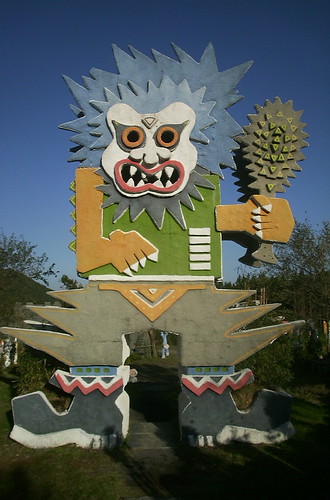
I wrote this for Jeju Life, and found out over a year later that it was never published because it was "not good enough" or whatever. I'll put it here so that maybe someone else will find out about this awesome place.
Unless you're about eight years old or really into monsters, you've probably never heard of Dokkebi Park, Jeju's premier monster related tourist attraction. The only mention of it in the English language guides available is a "goblin park" on one of the maps, no further information is given.
A dokkebi seems to be a sort of friendly, trick playing monster common in Korean folklore. Dokkebi are often shown having only one, cyclopean eye, and are commonly represented as having one or more horns. They also usually carry a club, which can be used to cast spells to summon anything they want (by stealing it from someone else). Still, they're supposed to be friendly, so don't freak out if you meet one while hiking.
Despite this lack of information, and because I'm really into monsters, I decided to go and check this place out. So off I went, armed with a Korean language brochure which promised statues of monsters and well, that's about all I could figure out to be honest. Still, that was enough for me.
Upon arriving at the park we received a pleasant surprise, an amazingly well written guide in English. Amazing! This was probably the best English information I received at any tourist attraction in Korea. I can only assume a bilingual monster fan happened by and wrote it for them, as none of the staff seemed to speak much English.
Most of the park is devoted to really strange statues and sculptures of dokkebi, some of these are really big, and all of them are pretty neat. In addition to the big statues, there are also examples of ones made from "junk" and small ones made of fimo. There's also a number of exhibitions that are more or less incomprehensible if you can't read Korean.
There's a few places that are actually kind of scary (seriously), so if you're easily scared you might want to skip the final performance and be on your guard while walking around the park. To counter balance the fear there is an enclosure with some cute bunnies.
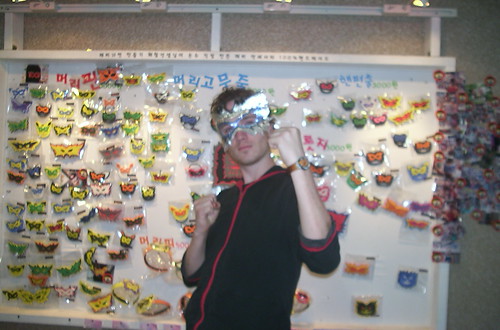
Probably the best thing at the park is the dokkebi mask making available in a building which also houses the gift shop. An employee will make you a neat silver foam mask in one of a number of designs. Then you get to colour in your mask following one of the many examples they have, or just creating your own thing! Fantastic!
The park is a must see for any big fans of monsters, and even if you're not, taking photos of monster statues is an amusing way to spend an afternoon.
Tickets cost 6000 Won for adults and 5000 Won for children. There's a discount (how much? I think it was 50%) if you have your foreigner card with you.
If you've decided you're really into dokkebi it's also worth a trip up to the "mysterious road." In Korean it's known as the "dokkebi road" and you'll see them decorating several of the shops and stalls. There's also a bunch of statues in an abandoned mini golf place a little bit up the road.
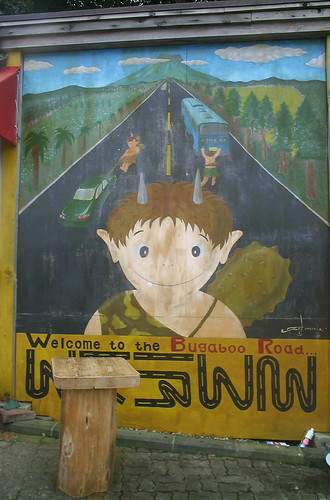
How to get there:
If you've got your own transport just drive down road x (Jim! I have no idea where it was, sorry... check your maps?). You'll see bizarre silver warriors where you have to turn off.
Getting to Dokkebi Park without your own transportation is incredibly frustrating. A bus from the main terminal will bring you past it, but it won't actually stop there. Instead it'll drop you off down the road by some weird mushroom houses. From there you'll have to walk about ten minutes back up the side of the road to Dokkebi Park. Not really recommended for children. Thankfully, going back into town is easier, as you should just be able to flag down a bus going down the road.
For more information try calling (064) 783-3013 or go to www.dokkebipark.com (only in Korean, but there's pictures!).
There's more photos here and here (the second link also features photos from Loveland, so maybe not worksafe).
Labels: manhwa, where else would I put it?

Monday, March 16, 2009
Banya the Explosive Delivery Man

This was written for Jeju Life, but I didn't even submit it, or even finish it really, after they didn't run the other review I wrote for them.
Fast. Precise. Secure.
Banya the Explosive Delivery Man
By Kim Young Oh
Five volumes from Dark Horse
$12.95US
While the title may lead you to think this series features mail carriers blowing up dogs, Banya is actually about a delivery person in the fictional Gaya desert. Though the act of Banya delivering things is really only there to allow him to encounter people he has to fight.
The first few volumes are Banya, and the other delivery people, Mei and Kong, just delivering things and fighting people.
Volumes four and five are when a plot more indepth than "get this thing to this location" kicks in and we start getting some of Banya's backstory. To be honest I liked these two books less than the first three. Mei and Kong are written out (to "protect" them, oh Banya), and we're introduced (or reintroduced) to some other characters: the evil guy who's trying to take over/destroy the world by gaining control of a dragon, the female summoner monk from earlier in the series who is trying to stop this, and a big strong guy who has a talking sword.
I would have prefered it if Banya had just continued making deliveries as more of his history was revealed. What I would have really liked to see was a story where Banya is delivering something for the "bad guys" and heroes are trying to stop him, but while he knows it's wrong, he feels he must deliver it anyway. Perhaps that will show up in the next comic I read about delivery people.
Despite my disinterest in the plot of the last two volumes, the art still holds up and you get some nice action fight scenes between more of the ugly, ugly villians. Plus it's translated by Derek Kirk Kim, indie comics superstar. Go read his comic "Same Difference and Other Short Stories."
Monday, March 09, 2009
Goong (궁)

Originally published in the January 2007 issue of The Ulsan Pear (you can find issues in pdf format at ulsanonline.com).
Che Kyung Shin was just a normal high school girl, but now she’s learning just how much being a princess sucks. Every day is scheduled down to the last minute, she can’t live with (or even see) her family anymore and her husband (the crown prince) is a jerk.
So Hee Park’s Goong is set in a world were Korea still has a royal family and operates as a constitutional monarchy. The royal family are absurdly popular with the general public, despite, or perhaps because of, their extreme ties to tradition. So when Shin Lee, the crown price or “seja,”
starts going to Che’s school, she’s excited. Until she actually talks to him and discovers he’s a jerk who she wants nothing to do with.
Unfortunately, things don’t go that way. It turns out that Che’s grandfather was best friends with the prince’s grandfather (the former king) and before the king died they decided that their grandchildren (Che and Shin) would marry. In the twenty-first century it seems unlikely that you could convince two teenagers, especially ones that don’t like each other, that they should get married, yet in volume two they do. So what happened?
At first Che is going to say no, but having her mother prodding her towards marriage because she would rather have her daughter be unhappy for the rest of her life than her father-in-law feel guilty, doesn’t exactly help. But when Che realizes that this could be a way for her family to escape the poverty they live in, she relents. She is willing to sacrifice herself for her family.
However, Shin’s motivations are nowhere near as self-sacrificing. The prince thinks Che is a clutz and a fool and only agreed to marry her because he knows the life of a princess is horrible. “Do you think I’m crazy enough to make the one that I love be forced to live in the palace like a doll? Since I don’t care what happens to you, I am letting you be sejabin [crown princess].” He also says that later, when things get really horrible, he’ll just divorce her. How nice!
At this point you can pretty much figure out this isn’t the start to a typical romance story.
It is, however, funny and mostly undercuts things expected from this type of comic. At times a page will show what will happen in normal romance comics, and then the next page will have what actually happens in Goong (usually featuring characters doing something stupid).
The art is heavily influenced by Japanese comics (as are most Korean comics), but it looks good
and works well with the story (a lot of effort has been put into making the characters’ clothes look fashionable). At times it becomes super-deformed, which is strange the first time you see it, but is part of this artistic style.
Romance stories aren’t really my thing, but Goong is good and different enough to pull me in. Will Che fall in love with Shin (don’t do it, he’s not worth it!) or will she end up with his brother who seems nice (yes!) but may be too good to be true?
Goong is one of the most popular comics currently being made in Korea, and has also been made into a TV drama. If you want to brush up on your Korean, you can pick up the graphic novels easily enough. Thankfully, it’s also now available in English, just check amazon or somewhere.
Tuesday, February 17, 2009
Laya, Witch of the Red Pooh

[I wrote this for jejulife, but they never ran it.]
Art and story by Yo Yo
Published by Tokyopop (English, two volumes) In Korea it appeared in Young Champ magazine.
Korea may be full of comic books, but it can seem like all of them are just translated imports from Japan. So where are the Korean comics? Thankfully it recent years a variety of publishers have been releasing Korean comics (Manhwa) in English, so now you can find out what the country has to offer.
After reading Laya, Witch of the Red Pooh I really wished that there was magic in the world again. I wished that I could have a friend who could cast magic spells and make magic potions and let me stay at her house indefinitely after I burnt mine down. I wished I could do magic myself, but I'd probably be just as lazy as Laya.
Laya is a witch; not a wizened old crone as usually seen in Western stories, but (as you probably already know from the cover) a young, cute witch. She's also very lazy, with still lazier friends who hang around her house distracting her from getting her job done.
Laya's friends include Puss, her cat who talks, walks around in boots, and is constantly smoking or drinking when he's not sleeping. Snowy the Crow, who has to stay in the form of a cute boy or Laya will kick him out. And Niky, another witch who can't go home because she burnt her house down.
The stories are pretty silly, and usually about Laya procrastinating doing witch work like making magic potions, trying to use magic to make her life easier, or the characters being incompetent in some way or another. Each story is only about four pages long, but a surprising amount can happen in those pages, and each character's personalities really come across well despite the limited space.
Most of the humour is pretty understandable without any knowledge of Korea, though the occasional joke my go over your head if you don't know anything about the country. (You might wonder what the name Digo Re is funny, until you realize they meant "Re" to be the family name, not the last name.)*
The artwork varies quite a lot; the best stuff being nice and detailed, with lots of work put into designing the clothes the characters are wearing and the backgrounds. Then there's the sorta super deformed stuff, and at the bottom is the rather poorly drawn stuff that seems to have been drawn when the artist was horribly behind on deadlines. Yet the occasionally bad art doesn't detract from the comic itself, instead it (somehow) still manages to be enjoyable.
While all the dialogue in the Tokyopop edition is in English, the sound effects have been left untranslated, allowing you to practice your Korean alphabet, or completely ignore them as the case may be.
At around 120-30 pages both books are a bit shorter than your average comic from Tokyopop, but both are still totally worth picking up if you're in the mood for something cute and funny.
*Re Digo = ready go.
Saturday, January 10, 2009
Comics World Busan
After I stopped updating this blog, I wrote a few articles and reviews for some magazines in Korea. Some of them were printed, some weren't. None of them are online now, so I might as well post them here.
Comic World Busan
Originally printed April, 2006 in The Ulsan Pear (you can find issues in pdf format at ulsanonline.com).
On March 25th I attended Comic World 32 at BEXCO in Busan, Korea. I had no idea what to expect. When I arrived outside the convention hall the first thing I saw were tons of people, and tons of cosplayers.
Cosplay is the Japanese (and Korean) word for dressing up as a character from a comic, cartoon or videogame. People put a lot of work into their costumes and friends will all dress up as characters from the same story so you’ll see gangs of people in weird clothing walking around together. They hang around outside and pose whenever people want to take their photos, and there are tons of people taking photos.
Inside the BEXCO building was quite different from outside, and a bit disappointing too. The large hall that contained everything wasn’t the nicest looking, but that doesn’t really matter that much. There were several rows of tables with dozens of booths set up in them.
Each booth contained not the piles of back-issues you might expect, nor did it feature any hot artists of popular comics, not even piles of mini-comics made by local creators. Instead, looking at what was offered at the booths, it was clear that this was a fan convention.
The booths had merchandise that featured characters from popular comics; usually badges, stickers, art prints, bags, cards, cell phone danglies and dōjinshi.
Well, not actually dōjinshi, that’s a Japanese word. Dōjinshi are usually fan comics. They’re fanfiction taken to the extreme. A fan will read a comic and like it a lot and decide to draw, publish and sell their own adventures of the characters.
The comics themselves are beautifully produced. Square bound and slightly larger than the usual American sized comics. They also usually have covers, and sometimes a few interior pages, in colour. The art is generally pretty good, though it probably won’t look exactly like the characters do in the comic. Also, because Korean reads left to right these comics read in the familiar direction instead of “backwards” like most Japanese comics.
Dōjinshi creators usually produce their comics in low print runs to avoid the chances of them getting sued (they are using other peoples characters after all). So if you see something cool, pick it up, you might not get another chance. A number of comic creators started by making dōjinshi before becoming famous, so maybe that neat looking comic was drawn by someone who’ll become famous.
Interestingly, the costumes, comics and other merchandise seen at Comic World really showed that the most popular comics in Korea are Japanese ones. Naruto, One Piece, Death Note, Full Metal Alchemist, Inu Yasha, Kerero (Sergeant Frog) and Gundamn were all clearly visible at the event and are all popular, or at least available, in English.
The Comic World Busan events happen fairly regularly, with the next one happening on May 27th and 28 th. I only know one thing for sure, next time I go to one of these things I’ll be in costume too. Now all I need to do is learn Korean so I can actually read these comics.
Visit the Comic World website at www.comicw.co.kr (in Korean).
Comic World Busan
Originally printed April, 2006 in The Ulsan Pear (you can find issues in pdf format at ulsanonline.com).
On March 25th I attended Comic World 32 at BEXCO in Busan, Korea. I had no idea what to expect. When I arrived outside the convention hall the first thing I saw were tons of people, and tons of cosplayers.
Cosplay is the Japanese (and Korean) word for dressing up as a character from a comic, cartoon or videogame. People put a lot of work into their costumes and friends will all dress up as characters from the same story so you’ll see gangs of people in weird clothing walking around together. They hang around outside and pose whenever people want to take their photos, and there are tons of people taking photos.
Inside the BEXCO building was quite different from outside, and a bit disappointing too. The large hall that contained everything wasn’t the nicest looking, but that doesn’t really matter that much. There were several rows of tables with dozens of booths set up in them.
Each booth contained not the piles of back-issues you might expect, nor did it feature any hot artists of popular comics, not even piles of mini-comics made by local creators. Instead, looking at what was offered at the booths, it was clear that this was a fan convention.
The booths had merchandise that featured characters from popular comics; usually badges, stickers, art prints, bags, cards, cell phone danglies and dōjinshi.
Well, not actually dōjinshi, that’s a Japanese word. Dōjinshi are usually fan comics. They’re fanfiction taken to the extreme. A fan will read a comic and like it a lot and decide to draw, publish and sell their own adventures of the characters.
The comics themselves are beautifully produced. Square bound and slightly larger than the usual American sized comics. They also usually have covers, and sometimes a few interior pages, in colour. The art is generally pretty good, though it probably won’t look exactly like the characters do in the comic. Also, because Korean reads left to right these comics read in the familiar direction instead of “backwards” like most Japanese comics.
Dōjinshi creators usually produce their comics in low print runs to avoid the chances of them getting sued (they are using other peoples characters after all). So if you see something cool, pick it up, you might not get another chance. A number of comic creators started by making dōjinshi before becoming famous, so maybe that neat looking comic was drawn by someone who’ll become famous.
Interestingly, the costumes, comics and other merchandise seen at Comic World really showed that the most popular comics in Korea are Japanese ones. Naruto, One Piece, Death Note, Full Metal Alchemist, Inu Yasha, Kerero (Sergeant Frog) and Gundamn were all clearly visible at the event and are all popular, or at least available, in English.
The Comic World Busan events happen fairly regularly, with the next one happening on May 27th and 28 th. I only know one thing for sure, next time I go to one of these things I’ll be in costume too. Now all I need to do is learn Korean so I can actually read these comics.
Visit the Comic World website at www.comicw.co.kr (in Korean).

